


Body Recomposition: The Complete Evidence-Based Guide to Losing Fat and Building Muscle

Updated: 3 days ago
What Is Body Recomposition?
Walk into almost any gym and you’ll hear people talking about either losing weight or building muscle.
Some are starting another aggressive diet in the hope of seeing the number on the scale drop as quickly as possible. Others are entering a “bulking phase,” accepting months of fat gain because they believe it’s the only way to build muscle.
But what if there was a better approach?
What if your goal wasn’t simply to weigh less—or more—but to improve what your body is actually made of?
That’s exactly what body recomposition is.
Body recomposition is the process of reducing body fat while simultaneously preserving—or even increasing—lean muscle mass. Instead of focusing solely on body weight, it focuses on improving body composition: the ratio between fat mass and fat-free mass.
At first glance, the difference might seem subtle.
In reality, it completely changes how you should evaluate progress.
Imagine two people who both weigh 80 kg (176 lbs).
One has 30% body fat, carries very little muscle and struggles to climb a flight of stairs without getting out of breath.
The other has 15% body fat, significantly more lean muscle and exercises regularly.
Although the scale shows exactly the same number, their bodies, health, strength and metabolic profile are completely different.
This is why body weight alone tells a very incomplete story.
The scale simply measures total mass.
It doesn’t know whether you’ve lost body fat, gained muscle, retained water or simply ate a large meal a few hours earlier.
Body composition, on the other hand, tells you how your body is changing, not just how much it weighs.
For this reason, body recomposition has become one of the most important concepts in modern strength training, sports nutrition and long-term weight management.
The goal is no longer to become the lightest version of yourself.
The goal is to become the healthiest, strongest and leanest version of yourself.
Why Losing Weight Isn’t Always the Right Goal
For decades, the fitness industry has celebrated one number above all others:
Body weight.
Lose 5 kg.
Lose 10 kg.
Lose 20 kg.
Success has almost always been measured by what the scale says.
The problem is that your body doesn’t distinguish between “good” weight and “bad” weight.
When you follow a restrictive crash diet without resistance training or adequate protein intake, your body doesn’t just lose fat.
It also loses muscle.
This is one of the main reasons why so many people regain weight after finishing a diet.
With less muscle, your body burns fewer calories each day, physical performance declines, hunger often increases and maintaining the new weight becomes progressively harder.
The result is a frustrating cycle that millions of people know all too well.
Diet.
Lose weight.
Regain weight.
Repeat.
Body recomposition breaks this cycle by changing the objective entirely.
I
nstead of asking,
“How much weight can I lose?”
you begin asking,
“How much fat can I lose while keeping—or even building—muscle?”
It’s a subtle change in mindset, but it leads to completely different decisions regarding nutrition, training and recovery.
Coach’s Insight
One of the first things we explain to new clients is that the scale is often the least interesting number in the room. Changes in waist circumference, progress photos, strength levels and body composition usually provide a much clearer picture of whether a program is working.

Why Body Composition Matters More Than the Scale
One kilogram of fat weighs exactly the same as one kilogram of muscle.
The difference lies in density.

Muscle tissue is considerably denser than fat tissue, meaning it occupies much less space for the same weight.
That’s why two people with identical body weight can look completely different.
It’s also why someone can maintain the same weight for several months while their clothes become noticeably looser, their waist shrinks and their physique looks dramatically leaner.
This often surprises people during a body recomposition program.
They expect the scale to move every week.
Instead, they begin noticing something much more meaningful.
Their jeans fit differently.
Their shoulders appear broader.
Their waist becomes smaller.
Friends and family comment on how much leaner they look.
Yet the scale may have changed very little.
This isn’t a sign that the program isn’t working.
It’s often a sign that it’s working exactly as intended.
For this reason, experienced coaches rarely rely on body weight alone.
Instead, they combine multiple measurements to build a complete picture of progress.
These commonly include:
Weekly body weight trends.
Waist circumference.
Hip and limb measurements.
Progress photos taken under consistent conditions.
Strength improvements in key exercises.
Body fat assessments, when available.
Looking at all these variables together provides a far more accurate representation of body recomposition than body weight alone.
Why Most Diets Fail
Almost everyone knows someone who has successfully lost weight.
Far fewer know someone who has maintained that transformation five years later.
This isn’t because people lack motivation.
It’s often because they follow strategies designed to produce rapid results rather than lasting ones.
Crash diets, detoxes and extremely low-calorie plans can certainly reduce body weight in the short term.
However, they frequently come at a cost:
Reduced training performance.
Increased fatigue.
Greater muscle loss.
Increased hunger.
Poor long-term adherence.
Eventually, the diet becomes impossible to sustain.
Old eating habits return, body weight increases again and many people conclude that they simply lack discipline.
In reality, the strategy—not the person—is often the problem.
Body recomposition follows a very different philosophy.
Rather than asking your body to lose as much weight as possible in the shortest amount of time, it focuses on creating sustainable habits that improve your physique gradually while maintaining muscle, performance and metabolic health.
Progress may be slower on the scale.
But it’s usually far more sustainable.
📊 Case Study Opportunity #1 — How Eating More Helped Chris Lose Fat and Rebuild His Physique

Chris is a top executive based in London.
Like many professionals, his routine revolved around long working hours, business dinners, frequent travel and irregular eating habits. Over the years, maintaining a healthy body composition became increasingly difficult despite repeatedly trying to “eat less” whenever his weight increased.
At first glance, the obvious solution seemed to be another calorie-restricted diet.
Instead, we took the opposite approach.
Rather than immediately reducing calories, we began with a structured reverse diet, gradually increasing his daily calorie intake while improving food quality, strength training and recovery.
For many people, this sounds completely counterintuitive.
How can eating more possibly lead to losing body fat?
The answer lies in creating a body that performs better, recovers better and is able to sustain higher levels of physical activity without feeling constantly deprived.
As calorie intake gradually increased, training quality improved, energy levels increased and adherence became significantly easier.
Only after restoring a more sustainable nutritional baseline did we introduce a controlled fat-loss phase.
The result wasn’t simply a lower body weight.
It was a completely different body composition. 📈 What Happened?

One of the most interesting aspects of Chris’ transformation is that his progress wasn’t linear.
As shown in the graph above, body weight initially decreased during the fat-loss phase before gradually increasing again.
If we looked only at the scale, it might appear that the program had stopped working.
The reality was exactly the opposite.
The weight regained during the final phase occurred alongside significant improvements in body composition, strength and muscular development.
This is one of the clearest examples of why the scale should never be interpreted in isolation.
📏 Looking Beyond Body Weight

Changes in circumference measurements tell a much more complete story than body weight alone.
Over the course of the program Matthias reduced fat from the areas where most people naturally accumulate it—particularly around the waist and abdomen—while preserving, and in some regions increasing, lean muscle mass.
This combination is exactly what defines successful body recomposition.
Rather than becoming simply “lighter,” he became leaner, stronger and metabolically healthier.
Coach’s Insight
One of the biggest misconceptions in the fitness industry is that every increase in body weight represents fat gain. In reality, when calories are progressively increased alongside structured resistance training, improvements in glycogen storage, hydration, digestive content and lean muscle mass can all contribute to higher body weight while body fat continues to decrease.
Can You Really Lose Fat and Build Muscle at the Same Time?
If you’ve ever searched online about body recomposition, you’ve probably found two completely opposite opinions.
Some people claim it’s impossible.
Others promise you’ll build muscle and lose fat at the same time with almost no effort.
Neither is entirely true.
Body recomposition isn’t a shortcut, nor does it violate the laws of human physiology.
It’s simply the result of creating the right environment for your body to use stored fat as fuel while simultaneously stimulating muscle growth.
Whether this happens depends on several factors, including your current body composition, training experience, nutrition, recovery and consistency.
For many people—particularly beginners, individuals returning to training after a break and those carrying excess body fat—building muscle while losing fat is not only possible, but one of the most common adaptations to a well-designed program.
For advanced athletes with years of resistance training and already low body fat levels, the process becomes slower and requires much greater precision.
The important takeaway is this:
Body recomposition is not an all-or-nothing phenomenon.
It’s a spectrum.
The better your nutrition, training and recovery work together, the greater your chances of improving body composition over time.
Your Body Doesn’t Have a “Fat Loss Mode” and a “Muscle Building Mode”
One of the biggest misconceptions in the fitness industry is the idea that your body can only do one thing at a time.
People often imagine metabolism as if it had two switches.
Either you’re burning fat.
Or you’re building muscle.
Human physiology is far more sophisticated.
Every minute of every day your body is simultaneously breaking down tissues, repairing muscle fibres, storing nutrients, releasing energy and adapting to the stress placed upon it.
After eating a protein-rich meal, muscle protein synthesis increases.
After resistance training, damaged muscle fibres begin repairing and adapting to become stronger.
Between meals, during sleep and throughout daily activity, stored body fat provides much of the energy needed to support these processes.
These adaptations happen continuously.
Body recomposition simply means that, over weeks and months, the balance shifts towards gaining lean tissue while gradually reducing fat mass.
The process isn’t determined by a single workout or a single meal.
It’s the cumulative result of hundreds of small decisions repeated consistently over time.
Coach’s Insight
One of the biggest mistakes I see is people looking for the “perfect” workout or the “perfect” diet. In reality, body recomposition rarely comes from doing one thing exceptionally well. It comes from doing many simple things consistently for long enough.
Why Protein Alone Isn’t Enough
If you’ve spent any time on social media, you’ve probably been told that eating more protein is the secret to body recomposition.
Protein is undoubtedly essential.
It provides the amino acids required to repair and build skeletal muscle, helps preserve lean mass during calorie restriction and generally increases satiety.
However, protein alone doesn’t build muscle.
Without progressive resistance training, your body has very little reason to invest energy into developing additional muscle tissue.
Think of protein as the building materials for a house.
Without an architect and construction workers, those bricks remain stacked on the ground.
Resistance training provides the blueprint.
Recovery provides the time.
Protein provides the raw materials.
All three must work together.
Training Creates the Signal—Nutrition Supports the Adaptation
Every strength-training session sends your body a simple message:
“This muscle is needed. Make it stronger.”
Your body then decides whether it has enough resources to respond to that message.
If training quality is poor, recovery is inadequate and calorie restriction is excessive, preserving muscle becomes difficult.
On the other hand, if resistance training is progressive, protein intake is sufficient and the calorie deficit is moderate rather than extreme, your body is much more likely to preserve—or even increase—lean muscle while gradually reducing body fat.
This is why body recomposition isn’t about finding the perfect calorie target.
It’s about creating an environment where your body can continue adapting positively week after week.
Why Extreme Diets Usually Slow Progress
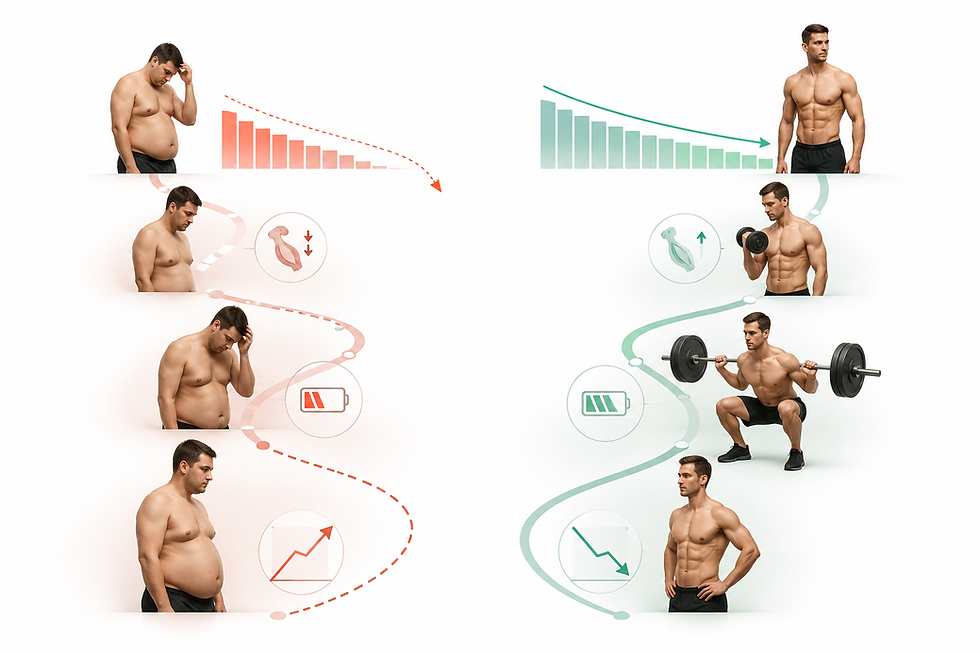
One of the biggest mistakes people make is believing that faster fat loss automatically leads to better results.
It often produces the opposite.
Large calorie deficits can certainly reduce body weight quickly.
Unfortunately, they also increase the likelihood of:
losing lean muscle mass;
reducing training performance;
increasing hunger;
slowing recovery;
making long-term adherence much more difficult.
In other words, they create the exact opposite environment needed for successful body recomposition.
This doesn’t mean fat loss should be slow at all costs.
It means it should be strategic.
A moderate calorie deficit combined with progressive strength training usually produces a much better balance between fat loss and muscle preservation than aggressive dieting.
Body Recomposition Requires Thinking in Phases, Not Extremes
Perhaps the biggest misconception is that body recomposition means eating exactly the same number of calories every day for months.
In practice, the most successful transformations are rarely linear.
Nutrition is often adjusted according to the individual’s starting point, training status, recovery capacity and long-term goals.
Some people benefit from beginning with a reverse diet to restore energy availability and improve training performance before entering a controlled fat-loss phase.
Others may start with a moderate calorie deficit before gradually increasing calorie intake to consolidate results and build additional lean muscle.
Rather than following one rigid diet indefinitely, successful body recomposition often involves strategic nutritional phases, each with a specific purpose.
The goal is never to diet forever.
The goal is to create a body that can maintain a lean physique while eating as much food as reasonably possible, supporting performance, recovery and long-term adherence.
📊 Case Study Opportunity #2 — Losing 25 kg by Eating More at the Right Time
Losing 25 kg Without Living on a Permanent Diet
For many people, successful weight loss is associated with eating less and less until the desired body weight is reached.
Matteo’s journey followed a different path.
When he started the program, he weighed almost 100 kg and had a body fat percentage of approximately 26%. Like many people trying to lose weight, his first instinct was to dramatically reduce calorie intake.
Instead, we focused on creating a strategy that could be maintained over the long term.
Rather than staying in a continuous calorie deficit for months, his nutrition was periodized into different phases. Periods of moderate fat loss were alternated with planned increases in calorie intake, allowing training performance, recovery and long-term adherence to remain high throughout the process.
This approach required more patience than a traditional crash diet, but it produced a far more sustainable transformation.

Over the course of the program, Matteo lost more than 25 kilograms while progressively improving body composition.
Perhaps more importantly, he achieved this without remaining in an aggressive calorie deficit for the entire journey.
Instead of constantly eating less, calories were strategically adjusted according to the objective of each phase.
This allowed him to continue training effectively, recover properly and maintain the consistency required for long-term success.
📈 Weight Progression

Unlike many rapid weight-loss programs, Matteo’s progress wasn’t perfectly linear.
There were weeks where body weight plateaued.
There were even periods where calories increased deliberately instead of decreasing.
Rather than viewing these phases as setbacks, they were planned components of the overall strategy.
The objective wasn’t simply to lose weight as quickly as possible.
It was to create a body capable of maintaining lower body fat while continuing to perform well inside and outside the gym.
📈 Calorie Progression

One of the biggest misconceptions in nutrition is that eating more inevitably leads to gaining fat.
Matteo’s journey demonstrates why context matters.
Whenever calorie intake was increased, it wasn’t because the diet had failed.
It was because the next phase required a body that could recover better, train harder and maintain higher levels of physical activity.
These strategic increases in energy intake reduced fatigue, improved adherence and created the foundation for further fat loss later in the program.
Rather than viewing nutrition as one long diet, it became a series of carefully planned phases, each with a specific purpose.
📉 Body Fat Progression

Although body weight was steadily decreasing, the real objective of the program was reducing body fat while preserving as much lean muscle mass as possible.
By the end of the transformation, Matteo had reduced his estimated body fat percentage by more than half.
This change explains why the visual transformation was considerably greater than the change in body weight alone would suggest.
📏 Circumference Measurements Tell the Real Story

Perhaps the clearest evidence of successful body recomposition comes from Matteo’s circumference measurements.
His waist circumference decreased by 21 cm.
His abdominal circumference decreased by 20.5 cm.
These changes indicate a substantial reduction in abdominal fat, one of the most important improvements for both health and long-term metabolic function.
Looking only at body weight would never fully capture the extent of this transformation.
Combining body weight, body fat percentage, circumference measurements and progress photos provides a much more accurate picture of what actually changed.
Coach’s Insight
The goal of body recomposition isn’t to spend months eating as little as possible. It’s to create a nutritional strategy that allows you to lose fat while continuing to train, recover and build habits you can realistically maintain for years.The most successful transformations rarely come from the most restrictive diets. They come from intelligent planning, consistency and knowing when to reduce calories—and just as importantly, when to increase them again.
Key Takeaway
Matteo’s transformation highlights one of the most important principles of body recomposition.
Successful fat loss isn’t about staying in a calorie deficit forever.
It’s about strategically moving between different nutritional phases based on your goals, training performance and recovery.
Over time, this approach made it possible to lose more than 25 kg, reduce body fat from approximately 26% to 12%, dramatically decrease waist circumference and build a physique that was not only leaner, but also stronger and more sustainable.
How to Start Your Own Body Recomposition Journey
By now, you’ve seen both the science behind body recomposition and real-world examples of people who successfully lost fat while preserving or building muscle.
The next question is straightforward:
How can you achieve similar results?
While every individual requires a personalized approach, successful body recomposition follows the same fundamental principles. Rather than searching for the perfect diet or training program, your goal should be to create an environment that allows your body to gradually reduce fat mass while maintaining—or even increasing—lean muscle tissue.
Let’s break down the most important factors.
1. Start With the Right Calorie Target
The biggest mistake people make is assuming they need to eat as little as possible.
In reality, body recomposition is rarely about starvation.
Instead, it is about matching calorie intake to your current situation.
If you have a relatively high body fat percentage, a moderate calorie deficit is often enough to stimulate fat loss while preserving muscle when combined with resistance training and adequate protein intake.
If you’re already lean or have spent months dieting, immediately reducing calories further may actually slow progress. In these situations, maintaining calories for several weeks—or gradually increasing them through a structured reverse diet—can improve training performance, recovery and long-term adherence before beginning another fat-loss phase.
The objective isn’t to lose weight as quickly as possible.
It’s to create sustainable progress that allows fat loss while keeping muscle.
Key Takeaway
The best calorie target is not the lowest one. It is the highest intake that still allows steady fat loss while supporting training performance.
2. Prioritize Protein Every Day
Among all nutritional variables, protein consistently has the greatest impact on successful body recomposition.
Adequate protein intake helps preserve lean muscle during periods of fat loss, supports recovery after resistance training and promotes muscle growth when combined with progressive overload.
For most active individuals, consuming approximately 1.6–2.2 g of protein per kilogram of body weight per day is an evidence-based target.
Rather than worrying about the exact timing of every meal, focus on reaching your daily protein goal consistently.
Simple, repeatable habits almost always outperform complicated nutrition strategies.

3. Make Resistance Training Your Priority
Body recomposition is not created by cardio alone.
Resistance training provides the stimulus that tells your body to preserve and build muscle tissue while fat is being lost.
This doesn’t mean you need to train six days per week or follow an advanced bodybuilding routine.
For most people, three to five well-designed resistance training sessions per week are sufficient to produce excellent results.
The key is progressive overload.
Over time, your muscles need a reason to continue adapting. This can come from gradually increasing the weight you lift, performing more repetitions, improving exercise technique or completing slightly more total training volume.
Your goal isn’t to destroy yourself during every workout.
It’s to become slightly stronger over the coming months.
4. Don’t Fear Cardio—Use It Strategically
One of the biggest misconceptions about body recomposition is that cardio destroys muscle.
The reality is far more nuanced.
When appropriately programmed, cardiovascular exercise complements resistance training by improving cardiovascular fitness, increasing daily energy expenditure and supporting overall health.
Low- to moderate-intensity cardio, such as brisk walking, cycling or Zone 2 training, is particularly useful because it has relatively little impact on recovery while contributing to a higher overall calorie expenditure.
The mistake is relying on cardio as your primary fat-loss strategy while neglecting resistance training.
Cardio helps create the calorie deficit.
Strength training determines what kind of weight you lose.
5. Be Patient Enough to Let Your Body Adapt
Body recomposition is slower than traditional weight loss.
This often frustrates people during the first few weeks.
The scale may remain relatively stable while body fat gradually decreases and lean muscle increases.
For this reason, relying exclusively on body weight can be misleading.
Instead, monitor several indicators together:
progress photos;
waist circumference;
body fat percentage (when available);
strength improvements;
how your clothes fit.
These measurements provide a much more accurate picture of changes in body composition than body weight alone.

How Long Does Body Recomposition Take?
One of the most common questions is how quickly body recomposition happens.
Unfortunately, there is no universal timeline.
The speed of progress depends on factors such as your starting body fat percentage, training experience, genetics, sleep quality, nutrition and consistency.
Beginners and individuals carrying higher levels of body fat often notice visible improvements within the first two to three months because they can lose fat and gain muscle relatively efficiently.
Experienced lifters usually progress more slowly, as building additional muscle becomes increasingly difficult over time.
Rather than expecting dramatic weekly changes, think in terms of months rather than weeks.
The most impressive transformations you’ve seen throughout this article were not created in thirty days.
They were built through consistent habits repeated over many months.
Common Body Recomposition Mistakes
Most unsuccessful body recomposition attempts are not caused by a lack of motivation. They are usually the result of a few common mistakes repeated consistently.
The most frequent errors include:
eating in an excessively aggressive calorie deficit;
neglecting resistance training;
consuming insufficient protein;
changing training programs every few weeks;
expecting visible changes within days rather than months;
relying exclusively on body weight to evaluate progress;
giving up after temporary plateaus.
Avoiding these mistakes is often more valuable than searching for advanced nutrition strategies or expensive supplements.
Frequently Asked Questions About Body Recomposition
Can beginners lose fat and build muscle at the same time?
Yes. Beginners are among the individuals most likely to experience successful body recomposition because resistance training provides a completely new stimulus while existing body fat can help supply energy during a moderate calorie deficit.
Can you build muscle without losing weight?
Absolutely. Body recomposition focuses on improving body composition rather than reducing body weight alone. Some people maintain the same body weight while significantly reducing body fat and increasing lean muscle mass.
Is cardio necessary for body recomposition?
No, but it can be a valuable tool. Resistance training should remain the primary focus, while cardio supports cardiovascular health, increases energy expenditure and improves overall fitness.
Do I need supplements?
Not necessarily. Most people can achieve excellent body recomposition results through appropriate calorie intake, sufficient protein, progressive resistance training and adequate recovery. Supplements should complement these fundamentals rather than replace them.
Final Thoughts
Body recomposition is not a shortcut, nor is it a temporary diet.
It is a long-term approach that focuses on improving body composition rather than simply reducing body weight.
As you’ve seen throughout this guide, successful transformations are rarely built on extreme calorie restriction, endless cardio sessions or perfect motivation. They are the result of consistently applying evidence-based principles, adjusting calorie intake when necessary, prioritizing resistance training and remaining patient long enough for meaningful physiological adaptations to occur.
The journeys of Matthias and Matteo demonstrate that sustainable body recomposition is possible in real life—not just in research studies. Different starting points, different lifestyles and different strategies ultimately led to the same outcome: less body fat, more lean muscle and better long-term health.
Whether your goal is to improve athletic performance, change your physique or simply become healthier, remember that body recomposition is measured by the quality of the weight you lose—not just the number on the scale.
Ready to Start Your Body Recomposition?
If you’re unsure where to begin, the first step isn’t choosing the perfect diet or workout. It’s understanding your current body composition, training history and lifestyle so you can build a strategy that fits your individual needs.
If you’d like a personalized plan based on evidence rather than guesswork, explore our coaching programs or book a Body Check to discover the most effective starting point for your body recomposition journey.

Comments