


Body Recomposition Workout: The Evidence-Based Guide to Losing Fat and Building Muscle

If your goal is to lose fat and build muscle at the same time, it’s easy to assume that you simply need to train more. More workouts, more cardio, more exercises and more calories burned must mean faster results.
In practice, successful body recomposition rarely works that way.
A well-designed body recomposition workout isn’t about burning as many calories as possible during every session. Its primary purpose is to give your body a strong enough reason to preserve—and potentially build—muscle while nutrition and daily activity help manage energy balance.
This distinction becomes especially important when you’re eating in a calorie deficit. If training becomes an endless attempt to burn more calories, fatigue can increase faster than your ability to recover. Strength starts falling, workouts become less productive and the muscular stimulus you’re trying to protect gradually disappears.
The better approach is to make resistance training purposeful, progressively challenge your muscles, manage overall training volume and use cardio and daily movement strategically rather than treating every form of exercise as another opportunity to burn calories.
In this guide, we’ll look at how often you should train, how progressive overload fits into body recomposition, how much cardio you actually need and how to tell whether your training program is producing the changes you want.
If you’re new to the concept of losing fat while building muscle, start with our Complete Evidence-Based Guide to Body Recomposition, where we cover the nutrition, calorie balance and physiological principles behind the process.

What Should a Body Recomposition Workout Actually Do?
The goal of a body recomposition workout is surprisingly simple: provide enough muscular stimulus to preserve or build lean tissue without creating more fatigue than you can recover from.
This is different from approaching exercise purely as a way to burn calories.
A hard resistance-training session certainly requires energy, but the calories burned during the workout are not its greatest contribution to body recomposition. The more important effect is the adaptation that follows it. When muscle is repeatedly exposed to sufficient mechanical tension, the body has a reason to maintain that tissue and, under the right conditions, build more of it.
This matters because weight loss and fat loss are not the same thing. An aggressive diet combined with large amounts of exercise may make the number on the scale fall quickly, but some of that weight can come from lean tissue. A successful body recomposition strategy aims to shift that balance towards losing predominantly fat while maintaining or increasing muscle.
That means your training program should not be judged by how exhausted you feel when you leave the gym. It should be judged by whether you can progressively perform better over time while recovering sufficiently to repeat the process.
Why Strength Training Is the Foundation of a Body Recomposition Workout
Resistance training should form the foundation of almost every body recomposition program because it provides the specific stimulus required to maintain and develop muscle.
You don’t need a complicated exercise library to achieve this. Squats and squat variations, hinges, presses, rows, pull-downs or pull-ups, lunges and appropriately selected isolation exercises can cover most muscular requirements when programmed correctly.
What matters more than choosing a supposedly perfect exercise is being able to perform it safely, progressively load it and repeat it consistently enough to measure improvement.
This is also why constantly changing exercises can become counterproductive. Variety has a place in training, but if movements change every week it becomes difficult to determine whether you’re actually getting stronger or simply doing something different.
During body recomposition, measurable progression is valuable. If body weight is gradually decreasing while you’re maintaining—or even increasing—performance across your major movements, that’s generally a much more encouraging sign than simply seeing how many calories your watch says you burned.

How Often Should You Train for Body Recomposition?
There is no magic number of weekly workouts that guarantees better body recomposition.
For many people, three well-structured resistance-training sessions per week can be enough to produce meaningful progress. Others may benefit from four or five sessions, particularly as training experience increases and more weekly volume is required.
The important question isn’t “How many days can I train?” but “How much productive training can I perform and recover from?”
Someone working long hours, sleeping six hours per night and dieting aggressively may progress better with three quality sessions than with a six-day program they struggle to recover from. On the other hand, an experienced lifter with excellent recovery may need additional sessions to distribute sufficient weekly volume without making individual workouts excessively long.
Training frequency is therefore a tool for organising volume, not a measure of commitment.
This becomes particularly clear when we look at real-world transformations.
Case Study: Why Three Workouts per Week Can Be Enough
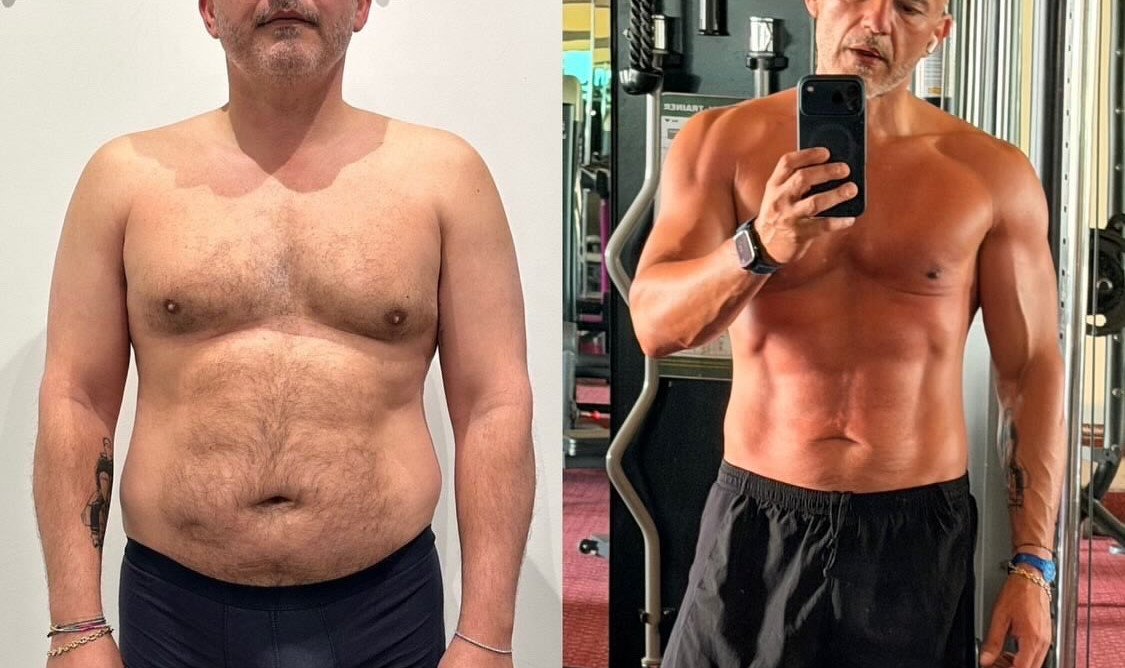
Matteo is a useful example because his transformation wasn’t built around living in the gym.
We introduced his broader transformation in our Complete Body Recomposition Guide, where his body weight eventually decreased by approximately 25 kg while his body composition changed dramatically. From a training perspective, however, one of the most interesting parts of the process was that much of his progress was achieved with just three resistance-training sessions per week.
Instead of continuously adding more training days, we focused on improving the quality and amount of productive work he could tolerate within those sessions.
As his strength, technique and work capacity improved, his training volume was progressively adjusted. The graph below shows how total volume changed across the process, with periods of increasing workload followed by deliberate reductions rather than a perfectly linear rise.

The important part of Matteo’s story isn’t that training volume simply went up forever. It didn’t, and it shouldn’t.
Training stress needs to respond to the person. Periods of higher volume can be followed by lower-volume phases, deloads or adjustments according to recovery, nutrition and performance.
Daily movement was managed separately through a step target. This allowed us to increase overall activity without trying to turn every resistance-training session into a calorie-burning circuit.
The division of roles was simple: resistance training provided the muscular stimulus;
daily movement contributed to energy expenditure; nutrition controlled energy intake.
That combination is far more useful than simply telling someone to exercise more.
Progressive Overload and Training Volume for Body Recomposition
Once your weekly training frequency is established, progression becomes the next priority.
Progressive overload means gradually increasing the challenge placed on your muscles as they adapt. Adding weight to the bar is one method, but it isn’t the only one. Progress can also mean performing more repetitions with the same load, improving range of motion, improving execution or gradually completing more productive training volume.
This is particularly important during body recomposition because progression isn’t always perfectly linear. During a calorie deficit, there may be periods where maintaining strength is itself a positive outcome.
Training volume also needs context. More volume can provide a stronger hypertrophy stimulus up to a point, but eventually additional sets create diminishing returns while fatigue continues to accumulate.
The objective is therefore not maximum volume. It is maximum productive volume that you can recover from.
Matteo’s data illustrates this well. His training volume increased substantially during parts of the transformation, but it also came down when appropriate. Those reductions weren’t failures; they were part of managing training over the long term.
Best Exercises and Workout Split for Body Recomposition
There is no special category of “body recomposition exercises.” The movements that effectively build muscle are the same ones that help preserve it while losing fat.
A good program will usually combine compound movements with selected isolation exercises and train the major muscle groups multiple times across the week.
For someone training three days per week, a full-body structure can work extremely well. A four-day program might instead use an upper/lower split.
Frequency | Example Structure | Best Suited For |
3 days/week | Full Body / Full Body / Full Body | Beginners, busy professionals, people in demanding deficits |
4 days/week | Upper / Lower / Rest / Upper / Lower | Intermediate trainees with good recovery |
5 days/week | Upper / Lower / Push / Pull / Legs | More experienced trainees requiring greater volume |
The split itself matters less than what happens within it. Each major muscle group needs enough quality work, exercises should remain stable long enough to measure progression and the program should fit your actual life rather than your ideal week.
A three-day program performed consistently for a year will almost always outperform a five-day program you repeatedly miss.

How Much Cardio and Daily Activity Do You Need for Body Recomposition?
Cardio can absolutely be part of a successful body recomposition program, but it shouldn’t replace resistance training.
Walking, cycling, running and other forms of cardiovascular exercise can increase energy expenditure and improve cardiovascular fitness. The problem begins when people try to create their entire calorie deficit through increasingly large amounts of cardio.
A simpler approach is to separate the different components of activity.
Resistance training builds or preserves muscle. Daily steps help regulate baseline activity. Cardio develops cardiovascular fitness and can contribute additional energy expenditure when needed.
This is why step targets can be so useful. Walking creates relatively little fatigue compared with adding another intense workout, yet thousands of additional steps accumulated across a week can meaningfully change overall activity.
There is no universal step target or ideal amount of cardio. Someone averaging 3,000 steps per day may benefit enormously from gradually moving towards 7,000 or 8,000, while someone already walking 12,000 daily may have little reason to push significantly higher.
Start with what you’re currently doing and adjust according to progress rather than chasing an arbitrary number.

Recovery: When More Training Becomes Less Effective
Training only works when you can recover from it.
If additional sessions cause performance to fall, soreness to remain constantly elevated and motivation to disappear, adding more training is unlikely to improve your results.
Sleep, calorie availability, stress and training history all influence how much work you can recover from. This is why the same program can be appropriate for one person and excessive for another.
Planned reductions in volume—often called deloads—can also be useful during longer training periods. A temporary reduction in workload does not mean you’re losing progress. It can allow fatigue to dissipate so productive training can continue.
Body recomposition is a long process. Your program should be designed for the next several months, not simply to survive next Monday’s workout.
How to Know if Your Body Recomposition Workout Is Working
The scale alone cannot tell you whether your training program is successful.
During body recomposition, body weight may fall slowly or remain relatively stable while fat mass decreases and lean tissue increases. Instead, look at several signals together.
Track your average body weight over time, waist measurements, progress photographs and, when reliable measurements are available, changes in body composition. At the same time, monitor training performance.
If your waist is decreasing while your strength is stable or improving, that’s usually a very encouraging combination.
If weight is falling rapidly but strength, energy and training performance are collapsing at the same time, the strategy may be too aggressive.
This is one reason why collecting multiple data points—as we did with Matteo—provides far more useful information than simply chasing a lower number on the scale.
Common Body Recomposition Workout Mistakes
Most training mistakes during body recomposition come from trying to accelerate a process that requires time. Common examples include adding excessive cardio when progress temporarily slows, constantly changing exercises, training every set to failure, increasing volume without considering recovery and judging workout quality by calories burned.
Another frequent mistake is reducing resistance-training intensity simply because you’re dieting. While adjustments may eventually become necessary, preserving a meaningful training stimulus is particularly important when calories are restricted.
You are giving your body a reason to keep muscle.
Don’t remove that reason precisely when muscle preservation matters most.
Frequently Asked Questions About Body Recomposition Workouts
Is three workouts per week enough for body recomposition?
Yes. Three well-designed resistance-training sessions can provide sufficient weekly stimulus for many people, particularly beginners and intermediate trainees. Training quality, progression and recovery matter more than simply accumulating gym days.
Should I do cardio every day during body recomposition?
Not necessarily. Cardio should be programmed according to your cardiovascular goals, current activity and ability to recover. Daily walking can often increase energy expenditure with less fatigue than adding frequent intense cardio sessions.
Should I lift heavy or use high repetitions?
Both can contribute to muscle growth when sets provide sufficient muscular stimulus. A good program normally uses a range of repetitions rather than relying exclusively on very heavy or very light training.
Can I do body recomposition without lifting weights?
Some improvement in body composition is possible through nutrition and other forms of exercise, but resistance training provides the strongest direct stimulus for preserving and building muscle. If simultaneous fat loss and muscle development are the objective, it should usually be a central part of the program.
How long should I follow the same body recomposition workout?
Long enough to measure meaningful progression. You don’t need to change your program every few weeks simply to create variety. Exercises can remain in a program for months when they’re productive, comfortable and still allowing progression.
Final Thoughts: Build a Body Recomposition Workout You Can Progress
The best body recomposition workout isn’t necessarily the hardest program or the one that requires the most days in the gym.
It’s the one that gives your muscles a sufficient reason to adapt, allows you to recover and can be progressively developed over time.
For some people, that may mean three resistance-training sessions per week combined with a daily step target. For others, four or five sessions may allow training volume to be distributed more effectively. The exact structure should change according to training experience, lifestyle, recovery and goals.
What shouldn’t change is the underlying principle: resistance training is there to build and preserve muscle, not simply to burn calories.
Nutrition and overall activity can then be adjusted to create the energy balance required for fat loss.
Matteo’s transformation is a good example of what this looks like in practice. The solution wasn’t to continuously add more workouts. It was to progressively improve the training stimulus, manage volume over time, control daily activity and allow the process to work for long enough to produce a meaningful change.
If you want to understand how training fits alongside calories, protein and nutrition, read our Complete Evidence-Based Guide to Body Recomposition.
And if you’d rather have your training, nutrition and progress data analysed around your individual starting point, you can apply for a Body Check to identify the most appropriate strategy for your body recomposition goal.



Comments