


FFMI Calculator: Understand Your Muscle Potential

Introduction
Looking for an FFMI calculator to track your muscle progress? Most people rely on weight or BMI, but those numbers don’t reveal how much actual muscle you’re carrying. BMI, in particular, often mislabels fit athletes as “overweight” while missing under-muscled individuals.
That’s where the Fat-Free Mass Index (FFMI) comes in. FFMI doesn’t just look at your weight—it strips away body fat and focuses on lean tissue: muscle, bones, and organs. This makes it one of the most accurate, science-backed ways to evaluate your physique, your athletic potential, and even your long-term health.
In this article, we’ll show you how to calculate your FFMI, what the numbers really mean, and how to use them to set smarter goals. You’ll also learn how to naturally raise your FFMI through training, nutrition, and recovery—while avoiding the common myths that hold people back.
Whether you’re a beginner curious about your progress or a seasoned lifter chasing your natural potential, FFMI is the metric that tells the real story.
Section 1: The Science Behind FFMI
What is FFMI?
The Fat-Free Mass Index (FFMI) is a formula that measures your lean body mass relative to your height:
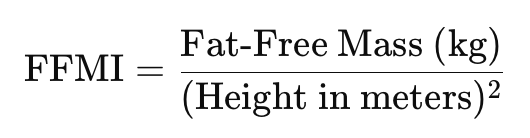
Fat-Free Mass (FFM) = body weight × (1 − body fat %).
Example: 174 cm, 66 kg, 11% body fat → FFM = 58.7 kg → FFMI = 19.4.
Unlike BMI, which can’t tell fat from muscle, FFMI reveals whether your lean mass is average, athletic, or exceptional.
Why FFMI is Superior to BMI
Accuracy: Studies in the American Journal of Clinical Nutrition show BMI misclassifies muscular people as overweight. FFMI fixes this by focusing on lean tissue.
Health marker: Low FFMI correlates with frailty, metabolic disorders, and worse outcomes in chronic disease (WHO, 2015).
Performance predictor: Higher FFMI within natural limits is linked to strength and athletic potential (PubMed ID: 28255574).
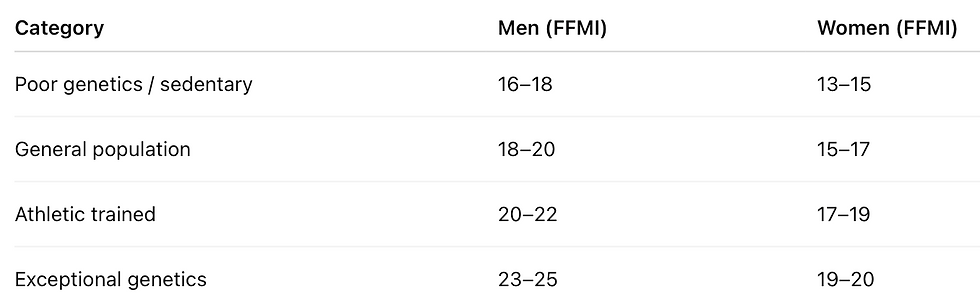
FFMI Ranges by Category
Section 2: Practical Applications
Step 1: Use an FFMI Calculator
Measure body fat (DEXA, calipers, or bioimpedance, RECOMP APP).
Enter weight, height, and body fat %.
Our FFMI calculator will do the math instantly.
Step 2: Track Progress Smarter
If your FFMI rises while body fat is stable → you’re adding muscle.
If FFMI drops → you may be losing lean mass, under-eating, or overtraining.
Step 3: How to Raise FFMI Naturally
Strength training:
Focus on compound lifts: squats, deadlifts, presses, pulls.
Train each muscle group at least 2x per week.
Protein intake:
1.6–2.2 g per kg of body weight daily (ACSM guidelines).
Energy balance:
Calorie surplus for muscle gain, moderate deficit for fat loss.
Recovery:
Sleep 7–9 hours.
Track recovery with HRV or readiness tools.
Manage stress to optimize anabolic hormones.
Section 3: Common Myths & Mistakes
Myth 1: “Higher FFMI always means healthier.”
Not true. Going above ~25 FFMI for men is usually only possible with anabolic steroids. Chasing extreme numbers can harm health.
Myth 2: “Women can’t reach high FFMI.”
False. While women average lower, elite female athletes regularly hit FFMI of 18–19—equivalent to athletic men at 21–22.
Mistake: “Only watching BMI or scale weight.”
Relying on BMI misses key details. FFMI helps you distinguish between being heavy from fat vs. heavy from muscle.
Section 4: Case Example
Meet Davide, 32 years old, 174 cm, 66 kg at 11% body fat. His FFMI = 19.4, placing him at the top of the “general population” range.
With one year of structured resistance training and a mild calorie surplus, he added 5 kg of lean mass while staying around 13% body fat. His new FFMI = 21.2, firmly in the “athletic trained” range.
What changed?
He hit the gym 3x per week with progressive overload.
Increased protein to 2 g/kg.
Tracked sleep and recovery.
Result: stronger, leaner, and healthier blood markers. His FFMI gave him a clear metric to measure progress beyond the scale.

Conclusion
The FFMI calculator is one of the most powerful tools for anyone serious about fitness. Unlike BMI, it reveals how much lean muscle mass you carry for your height, offering a smarter measure of progress, potential, and health.
If your FFMI is average, that’s your starting point—not your limit. If it’s in the athletic range, you’re on the right track. And if you’re chasing your natural ceiling, remember: consistent training, proper nutrition, and recovery are what truly move the needle.
Numbers matter, but what you do with them matters more.
👉 Try our free FFMI calculator today and discover where you stand.
Book here your test!



Comments