


Body Recomposition vs Bulking: Should You Recomp or Bulk?

If your goal is to build more muscle, deliberately increasing calories can seem like the obvious next step. Traditional fitness advice has reinforced this idea for decades: if you want to get bigger, you need to bulk.
There is some logic behind it. Building muscle requires energy, sufficient protein, progressive resistance training and adequate recovery. Providing more energy can therefore become useful, particularly as someone becomes leaner and more experienced in the gym. However, this does not mean that every person who wants more muscle should immediately start gaining body weight.
Gaining weight and building muscle are not the same thing. A calorie surplus creates additional energy availability, but it does not guarantee that every additional kilogram will become muscle. Whether a dedicated gaining phase makes sense depends on your current body composition, training experience, nutritional history and, most importantly, what is actually limiting your progress.
One of my clients, Marco, provides a particularly useful example because we used both body recomposition and lean bulking during the same long-term transformation.
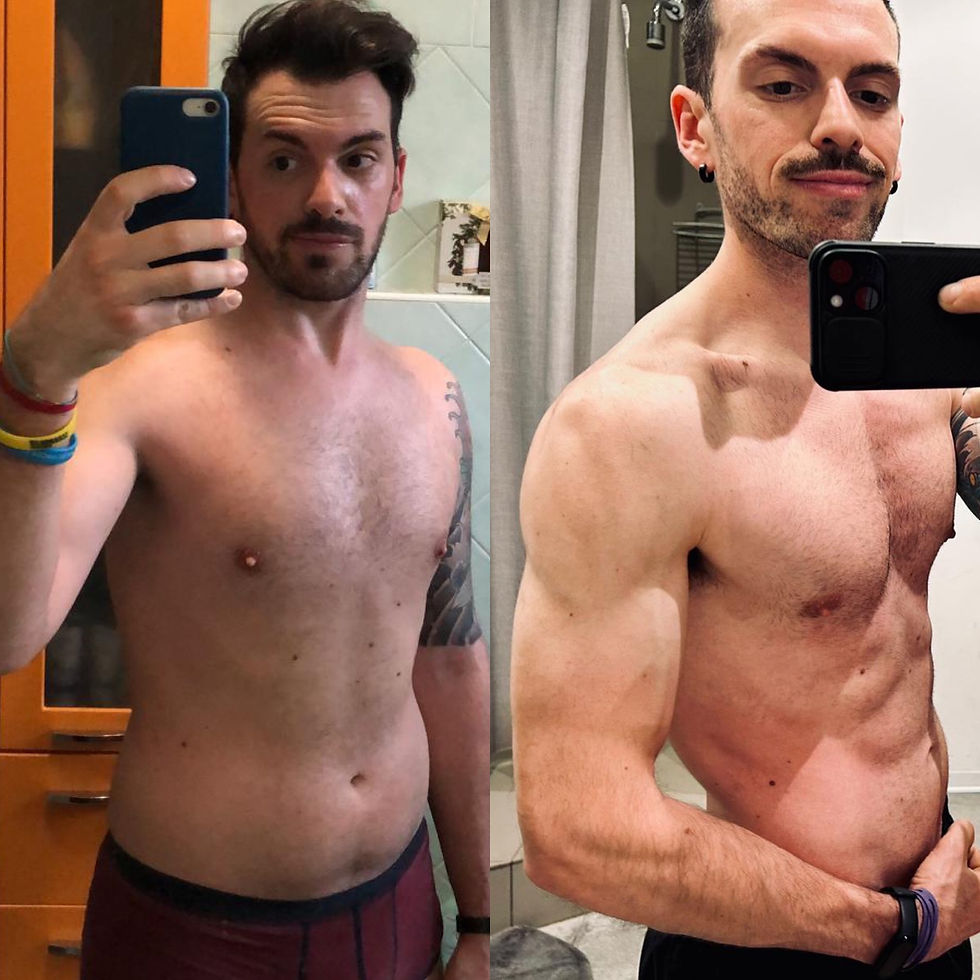
When Marco began, deliberately gaining more weight would have made little sense. He carried considerably more body fat and had a relatively limited muscular base. The first objective was therefore to improve the relationship between fat mass and muscle mass through structured resistance training, appropriate nutrition and body recomposition.
Later in the journey, the situation had completely changed.
Marco was lean, considerably more muscular and had developed a strong resistance-training foundation. Fat loss was no longer the main factor limiting the physique he wanted to build.
At that point, remaining at the same body weight indefinitely would have made additional muscular development increasingly difficult, so we moved into a controlled muscle-building phase.
The same person therefore required two very different nutritional strategies at different moments of his transformation.
The question isn't whether body recomposition or bulking is better. The question is which strategy solves the problem your body currently has.
Body Recomposition vs Bulking: Quick Comparison
The fundamental difference between body recomposition and bulking is not simply whether you eat at maintenance or in a calorie surplus. The two strategies prioritize different outcomes.
Body Recomposition | Lean Bulking | |
Primary goal | Reduce fat while building or preserving muscle | Prioritize muscle gain |
Calories | Maintenance or context-dependent deficit | Controlled calorie surplus |
Weight trend | Stable, decreasing or changing slowly | Gradually increasing |
Fat loss | Usually part of the objective | Not the primary objective |
Muscle gain | Possible | Primary objective |
Fat gain | Ideally reduced | Some may occur |
Best suited for | Depends on body composition and training status | Often leaner, trained individuals |
Progress measures | Waist, photos, strength, weight, body composition | Weight, performance, measurements, waist, body composition |
Main risk | Remaining in recomp too long as progress slows | Excessive surplus and unnecessary fat gain |
For someone carrying more body fat while still having substantial potential to build muscle, body recomposition can provide an efficient starting point. For someone who is already relatively lean, consistently trained and struggling to add further muscle, deliberately increasing energy availability may eventually become more productive.
This distinction becomes clearer when we look at what happened with Marco.
What Is Body Recomposition?
Body recomposition aims to improve the relationship between fat mass and lean mass, ideally by reducing body fat while simultaneously increasing or preserving muscle tissue.
Because one compartment can decrease while another increases, scale weight does not necessarily change dramatically. Someone could lose several kilograms of fat while gaining lean tissue and see a relatively small change in total body weight, despite looking considerably different.
This makes body recomposition particularly attractive for beginners, people returning to resistance training after a long break and people carrying moderate or higher levels of body fat. These individuals often have greater potential to gain muscle while simultaneously reducing fat than a highly trained, very lean athlete.
For a complete explanation of the process, you can read my Body Recomposition: The Complete Evidence-Based Guide to Losing Fat and Building Muscle.
What Is Lean Bulking?
A muscle-building or bulking phase intentionally increases energy intake above estimated maintenance in order to create nutritional conditions that support progressive training, recovery and muscular development.
The problem is that the word bulking is often associated with eating as much as possible and accepting substantial fat gain under the assumption that more calories will inevitably create more muscle. That is not the approach I use.
A lean bulk involves a controlled increase in energy intake while monitoring how body weight, waist circumference, body composition and training performance respond. The objective is not to increase scale weight as quickly as possible. It is to provide enough energy to support muscular development while limiting unnecessary fat accumulation.
That distinction becomes particularly important as training experience increases.
Phase 1: Why Marco Needed Body Recomposition Before Bulking
When Marco began his transformation, the main problem was not that he weighed too little. Although his long-term goal included developing substantially more muscle, immediately increasing his calorie intake to force body weight upward would not have addressed his starting body composition.
Instead, we first focused on improving the ratio between fat mass and muscularity. Resistance training became progressively structured, nutrition was adjusted according to his response, protein intake supported the training stimulus and body fat gradually decreased while his muscular base improved.
The first before-and-after comparison shows a major physical transformation, but the important lesson is not simply that Marco became leaner. It is that wanting more muscle did not automatically make bulking the correct first strategy.
A person can want to become more muscular while still benefiting from a period where body weight remains stable or even decreases. What matters is whether the current limiting factor is insufficient muscle, excessive fat relative to muscle, poor training quality, or some combination of these variables.

Do You Need a Calorie Surplus to Build Muscle?
A deliberate calorie surplus is not always required to gain muscle.
Muscle growth requires an effective resistance-training stimulus, sufficient protein, adequate recovery and enough available energy to support adaptation. Where that energy comes from, however, depends partly on the individual.
Beginners, detrained athletes and individuals with higher levels of body fat can sometimes gain muscle while eating around maintenance or even while losing body weight. Research in resistance-trained individuals has also demonstrated that increases in fat-free mass can occur without a deliberate surplus under specific conditions, although this should not be interpreted to mean that calorie deficits are optimal for maximizing hypertrophy in every population.
As someone becomes leaner and more highly trained, the situation changes. Additional muscle becomes progressively more difficult to build, and deliberately increasing energy availability can become more useful.
In other words, the more advanced you become, the less sensible it may be to expect significant muscle gain while simultaneously asking your body to lose substantial fat.
Marco's Weight History Shows Why Body Composition Should Be Managed in Phases
Looking at Marco's long-term weight graph provides a useful illustration of this concept. His body weight did not simply increase from the beginning of the programme until the end, nor did it continuously decrease.
There were phases of weight reduction, periods where weight increased, subsequent reductions and later another deliberate gaining phase. This was not a lack of consistency. It reflected a change in the objective of the programme as his body composition evolved.
During an earlier phase, reducing fat while building a stronger muscular foundation was valuable. Later, once he became leaner and more trained, deliberately allowing body weight to increase provided a better environment for further muscle development.
Long-term body composition therefore rarely follows one continuous direction. Trying to force every stage of a multi-year transformation into one nutritional strategy can eventually become counterproductive.

Calories During Body Recomposition vs Lean Bulking
The calorie strategy should change according to the objective of the phase.
During body recomposition, energy intake may sit around maintenance or within an appropriate deficit depending on body composition, training status and the desired rate of fat loss. During a muscle-building phase, a controlled surplus can then be introduced when additional energy is likely to support a meaningful increase in training capacity and muscular development.
However, there is an important step before deciding on either strategy: establishing a reasonable estimate of the person's actual maintenance intake.
Calorie calculators are useful starting points, but they remain estimates. If someone believes their maintenance is 2,300 calories while their seven-day average body weight continues increasing at that intake, their real-world response tells us that the initial estimate needs to be reconsidered.
This is why I prefer to look at calorie intake alongside weight trends, activity, training performance, body measurements and recovery before making large adjustments.
You cannot intelligently create a calorie surplus if you have no reasonable understanding of what the person is currently maintaining their body weight on.
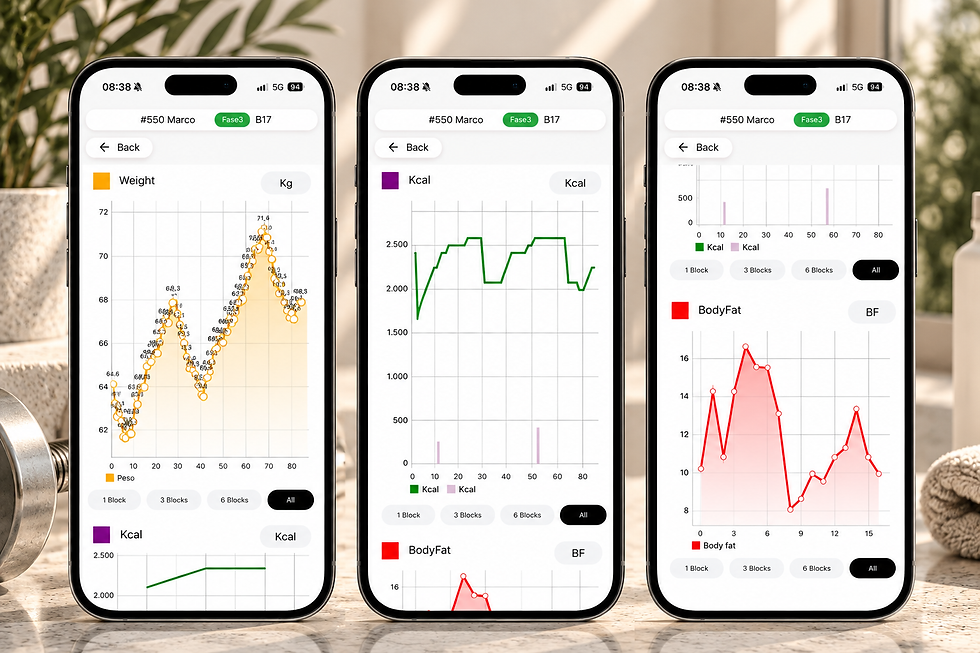
The graph is useful because it shows something that is often lost in simplified fitness advice: calories do not have to move in one direction forever. There were periods where we provided more energy and periods where intake was reduced again. The nutritional intervention followed the current objective.
How Large Should a Calorie Surplus Be?
There is no universally optimal calorie surplus that has been demonstrated to maximize muscle growth for everyone.
Muscle-building potential differs significantly depending on training experience, genetics, sex, body size, current body composition, training quality and recovery. A beginner can potentially build tissue much faster than an advanced natural lifter who has already accumulated years of structured training.
This makes the traditional recommendation of simply adding a fixed number of calories to everyone overly simplistic.
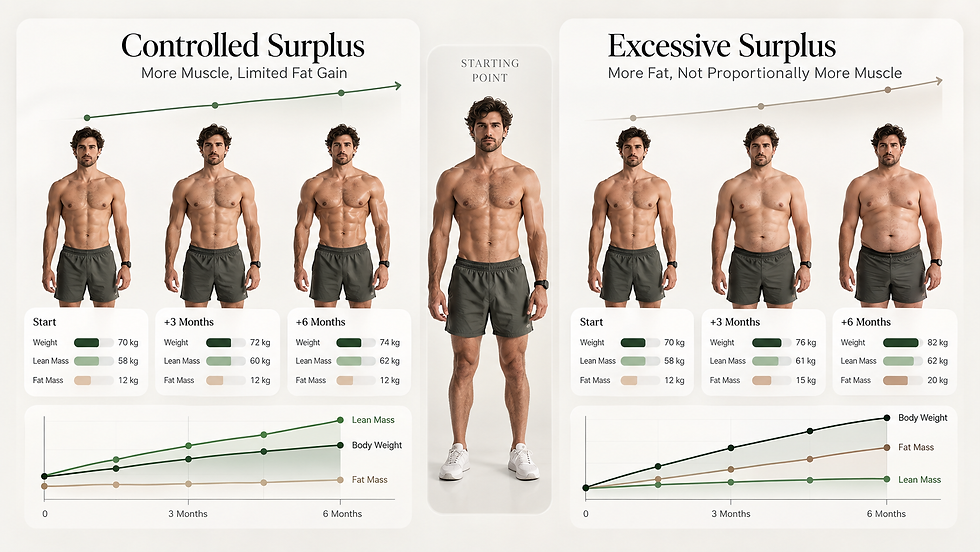
Research comparing different rates of weight gain in resistance-trained individuals also suggests that larger surpluses may primarily accelerate fat accumulation rather than producing a proportional increase in muscular development. Once enough energy is available to support training and adaptation, additional calories do not automatically become additional muscle.
For that reason, the purpose of a lean bulk is not to find the maximum amount of food someone can tolerate. It is to identify a level of energy intake that supports progressive training and gradual tissue gain while keeping unnecessary fat accumulation under control.
The Turning Point: When Recomposition Was No Longer the Best Strategy
The second part of Marco's journey is what makes this case study particularly relevant to the question of body recomposition vs bulking.
After the first major transformation, he was no longer dealing with the same physiological situation. He was significantly leaner, had established consistent resistance training and had already developed substantially more muscle than at the beginning.
At this point, further fat loss was not the main factor limiting the physique he wanted. Additional muscular size had become more important.
Trying to stay at the same body weight indefinitely while simultaneously attempting to gain meaningful amounts of muscle would have progressively reduced the efficiency of the strategy. We therefore shifted the objective from improving fat-to-muscle ratio toward deliberately supporting further muscle development.
The strategy changed because Marco had changed.
That distinction is important because nutritional phases should not become identities. Someone who begins with a successful recomp does not have to remain in a recomp forever. Similarly, someone who is currently bulking should not assume that increasing weight indefinitely will continue to be productive.

Why We Eventually Chose a Lean Bulk
The decision to enter a gaining phase was not based on the calendar or the idea that everyone needs a “bulking season.”
Marco was relatively lean, resistance training was well established, progressive overload had become part of the programme, nutrition was consistent and additional muscle had become the primary physical objective. Under those conditions, deliberately increasing energy availability made sense.
This is the context in which a lean bulk becomes useful. The surplus supports an existing training process; it does not replace that process.
If resistance training is poorly structured, adding more calories does not guarantee that additional body weight will represent useful tissue. Before increasing food substantially, I therefore want to know whether the person is training with enough volume, appropriate effort, progressive overload and sufficient recovery.
Nutrition can support the adaptation, but the resistance-training stimulus is what gives the body a reason to build muscle.
What Does Marco's 7 kg Gain Actually Mean?
During Marco's dedicated gaining period, body weight increased by roughly 7 kg, while he remained relatively lean and visibly developed significantly greater muscular size.
It is important to describe this result accurately. An increase in body weight during a lean bulk does not mean that every kilogram represents newly created skeletal muscle. Weight gained during a muscle-building phase can include muscle tissue, glycogen, the water stored alongside glycogen, other lean tissue and some amount of fat.
If a validated or consistently used body-composition method documents approximately 7 kg of additional estimated lean body mass, that can be reported as estimated lean body mass, but lean body mass itself should still not be described as identical to skeletal muscle mass.
This distinction does not weaken the result. The photographs, body-weight trend, body-fat monitoring and training progression already provide a much more complete picture.
Marco moved from the mid-60 kg range into the low-70 kg range during the gaining phase while remaining comparatively lean and displaying clearly greater muscular volume.
When Gaining Weight Became a Positive Outcome
This creates an interesting contrast with the first phase of Marco's transformation.
During body recomposition, a rapid increase in body weight would not have represented the objective. During the lean bulk, however, a gradual upward weight trend became useful because additional tissue was now part of what we were trying to achieve.
The number on the scale had not changed. Its meaning had changed.
That is why I rarely interpret weight, calories or body-fat percentage in isolation. The same increase in body weight could represent progress in one phase and an indication that calories need to be reduced in another.
During Marco's muscle-building phase, weight was therefore evaluated alongside waist circumference, body-fat trend, visual appearance, training performance and muscular development. If body weight had increased rapidly while waist circumference increased disproportionately and training progress remained limited, there would have been little reason to continue pushing calories higher.
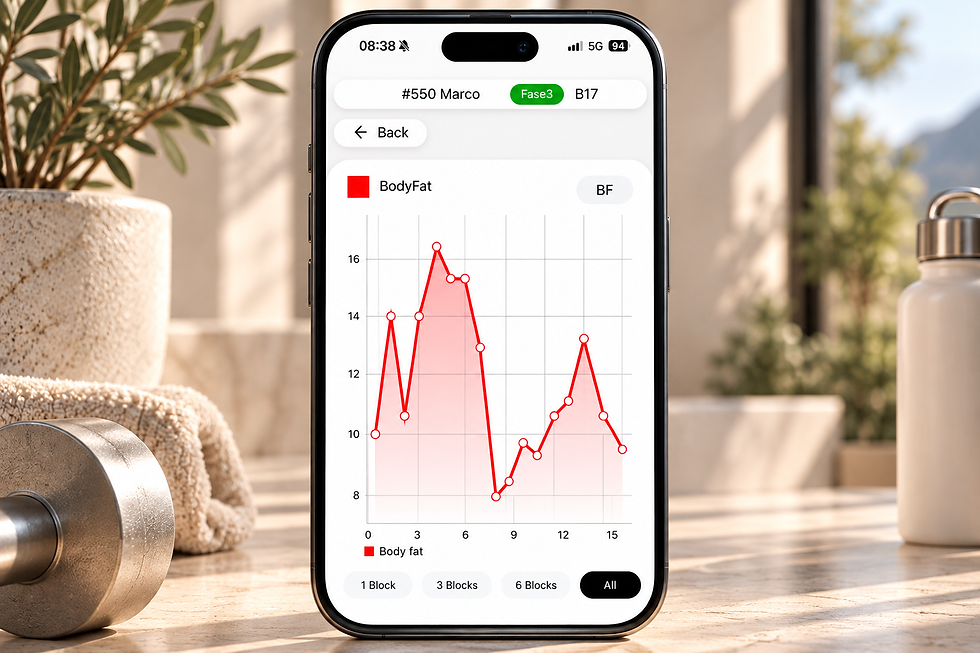
Body-fat measurements inevitably contain error, which is why consistency and longitudinal trends are more useful than treating one individual reading as perfectly accurate.
Which Approach Builds Muscle Faster?
For a relatively lean and experienced lifter whose primary goal is additional muscle, a controlled surplus can become more efficient than trying to maintain a permanent recomposition strategy.
That does not mean that calories themselves build muscle.
Resistance training still provides the primary stimulus, while protein and total energy intake provide part of the nutritional environment required to recover and adapt. A larger surplus cannot force muscle tissue to grow indefinitely faster because human adaptation has physiological limits.
The practical objective is therefore not to maximize the rate at which body weight increases. It is to create the conditions where performance and muscular development can improve without accumulating substantially more fat than necessary.
This is also why the quality of the training programme becomes increasingly important during a gaining phase. If there is no progressively challenging stimulus, the fact that someone is in a calorie surplus tells us very little about the quality of the weight they are gaining.
Protein Matters During Both Recomposition and Bulking
Moving into a calorie surplus does not make protein less important.
Research on resistance training consistently supports the importance of sufficient total daily protein for maximizing muscular adaptations. For many resistance-trained adults, a practical intake around 1.6–2.2 g/kg/day provides a useful range, with the exact requirement depending on energy intake, training status, leanness and individual circumstances.
The important point is that these variables work together. A calorie surplus cannot compensate for poor resistance training, and high protein intake cannot compensate for a programme that provides no meaningful progressive stimulus.
Body composition improves when the training stimulus, nutritional resources and recovery environment are aligned.
Should Skinny-Fat People Bulk or Recomp?
People described as “skinny-fat” are a good example of why low body weight does not automatically mean bulking is the correct choice.
Someone may have a relatively normal or low scale weight but still carry little muscle relative to their level of body fat. If that person immediately starts an aggressive surplus simply because they want to become more muscular, they may increase body fat considerably before developing enough muscle to change the overall appearance of the physique.
In many cases, beginning with structured resistance training, sufficient protein and appropriately controlled calories provides a better starting point. Muscle can begin to develop while the relationship between fat and lean mass improves.
Once that process becomes less productive and the individual is leaner, stronger and more trained, a dedicated gaining phase may eventually become appropriate.
Marco's journey demonstrates exactly why the answer can change over time.
Recomp vs Bulk for Beginners and Advanced Lifters
Beginners usually have substantial adaptation potential because resistance training itself represents a novel stimulus. As a result, they often do not need to deliberately maximize scale-weight gain from the beginning in order to develop muscle.
Before thinking about bulking, establishing exercise technique, progressive overload, sufficient protein and consistent training will often provide significant early progress.
Advanced lifters face a different problem. As muscular development increases and someone moves closer to their natural potential, further gains become progressively slower. Staying at exactly the same body weight indefinitely may then make substantial new muscle growth unnecessarily difficult.
For these individuals, a controlled surplus can become increasingly useful.
This leads to an important principle: a successful body recomposition phase can eventually create the exact conditions in which lean bulking becomes the more appropriate strategy.
Should You Bulk Based on Body-Fat Percentage?
Simple body-fat thresholds are popular online because they make decision-making appear easy. Rules such as “bulk below X% and cut above X%” are convenient, but they ignore a large amount of individual context.
Body-fat measurements themselves contain error, and the same estimated percentage can represent very different physiques depending on muscularity, fat distribution, sex and training history.
A lean beginner still has substantial recomp potential, whereas someone with the same body-fat estimate and ten years of structured resistance training may benefit more from a dedicated muscle-building phase.
For that reason, body-fat percentage is useful information, but it should inform the decision rather than make the decision.
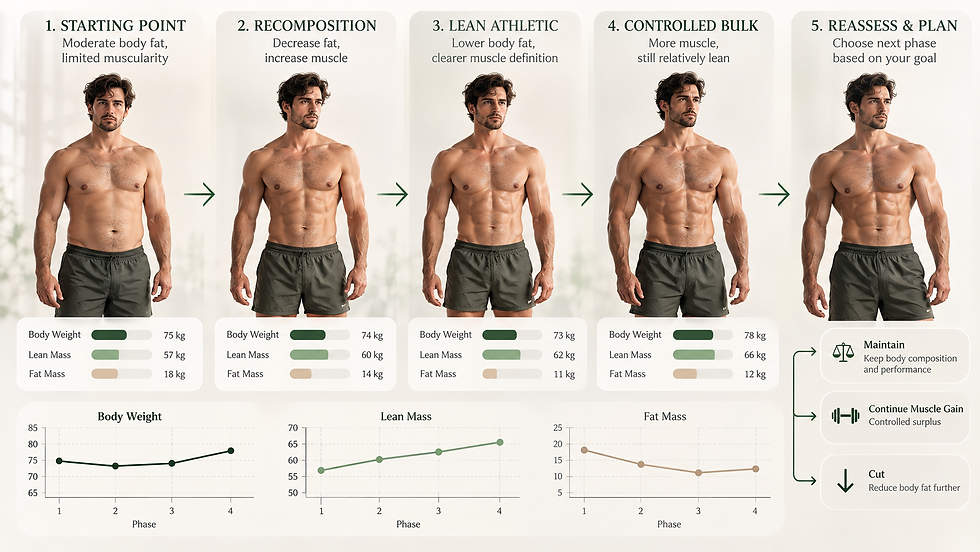
Body Recomposition → Lean Bulk → Reassess
Marco's journey can be simplified into a sequence of changing priorities.
He started with relatively higher body fat and lower muscularity, making body recomposition an appropriate strategy. Once he became leaner and developed a stronger muscular base, additional muscle became the primary limitation. We therefore transitioned into a controlled gaining phase.
After a gaining phase, the next step should once again depend on the data. Someone may continue gaining, move into maintenance or enter a fat-loss phase if body fat has increased enough to make that the new priority.
There is no requirement that everyone follows the same sequence, but the underlying principle remains consistent: the strategy should change when the limiting problem changes.
Why You Shouldn't Recomp Forever
Body recomposition is extremely useful when simultaneous fat loss and muscle development remain realistic, but it should not become a permanent nutritional identity.
Had we insisted on keeping Marco at exactly the same weight because body recomposition was the strategy that initially worked, we would eventually have made the strategy itself one of the limitations.
The recomp phase had achieved its purpose. Marco was significantly leaner, better trained and more muscular. At that point, gaining some additional body weight was no longer something to avoid. It became part of the process required to pursue the next objective.
The opposite is equally true. A successful lean bulk should not continue indefinitely simply because the person is currently trying to gain muscle. Once fat accumulation begins to outweigh the benefit of continued gaining, maintenance or a fat-loss phase may make more sense.
Long-term progress requires being willing to leave behind the strategy that produced your previous result when your current problem becomes different.
Marco's Case: Same Person, Two Different Problems
Marco — Phase 1 | Marco — Phase 2 | |
Main limitation | Higher fat relative to muscularity | Insufficient muscular size |
Primary goal | Improve fat-to-muscle ratio | Build more muscle |
Strategy | Body recomposition | Lean bulk |
Calories | Around needs or controlled deficit depending on phase | Controlled surplus |
Weight trend | Down or variable | Gradually upward |
Training focus | Build foundation and muscle | Progressive muscle development |
Progress markers | Fat loss + muscular improvement | Performance + muscularity + controlled fat gain |
Outcome | Leaner physique | Larger muscular physique |
Marco's case demonstrates why body recomposition and bulking should not be viewed as rival philosophies. They are different tools that can be used by the same person at different stages of a transformation.

Body Recomposition vs Bulking: A Practical Decision Framework
There is no single body-fat percentage, calorie intake or scale weight that determines whether someone should recomp or bulk. I prefer to evaluate the person's entire starting point.
Situation | Strategy to Consider |
Beginner with moderate body fat | Recomp |
Returning after detraining | Recomp |
Skinny-fat physique | Often recomp |
Higher body fat | Usually not the ideal time to begin a bulk |
Lean beginner | Recomp may still work well |
Lean intermediate | Depends on current progress and goals |
Lean advanced lifter | Lean bulk may become more efficient |
Additional muscle is clearly limiting the goal | Consider a lean bulk |
Maintenance calories unclear | Establish the baseline first |
Weight and waist increasing too quickly | Reassess the surplus |
The process I use can be summarized as:
Assess → Establish Maintenance → Identify the Limiting Factor → Choose the Phase → Measure → Adjust
Marco initially had body fat and limited muscularity as part of the problem. Later, additional muscle became the primary limiting factor. The mistake would have been trying to solve both situations using exactly the same nutritional strategy.
Frequently Asked Questions
Is Body Recomposition Better Than Bulking?
Neither is universally better. Body recomposition prioritizes improving fat mass and muscle simultaneously, whereas lean bulking prioritizes additional muscle development. Which strategy is appropriate depends on body composition, training experience and the current objective.
Should I Bulk or Recomp?
Beginners, detrained individuals and people carrying moderate or higher body fat often have good reasons to consider recomp first. Relatively lean and experienced lifters whose muscle gain has slowed may benefit more from a dedicated gaining phase.
Can You Build Muscle Without Bulking?
Yes. Muscle gain can occur without a deliberate calorie surplus, particularly in beginners, detrained individuals and other favourable circumstances. However, additional muscle becomes progressively harder to build as someone becomes leaner and more advanced.
Is a Calorie Surplus Necessary for Muscle Growth?
Not in every situation. A surplus becomes more useful when muscle development is the clear priority and maintaining the same body weight is beginning to limit progress.
Does a Bigger Calorie Surplus Build More Muscle?
Not necessarily. Larger surpluses can produce faster body-weight gain, but research suggests that much of the additional gain may be body fat rather than proportionally greater muscle development.
Should Skinny-Fat People Bulk?
Often not immediately. Developing a better muscular base while controlling body fat may be more useful before deliberately pursuing significant weight gain.
At What Body-Fat Percentage Should I Bulk?
There is no universal threshold. Body-fat percentage should be interpreted alongside muscularity, training history, fat distribution, goals and measurement accuracy.
When Should You Stop Recomping and Start Bulking?
A gaining phase becomes more reasonable when you are relatively lean, training consistently, recovering well and additional muscular size has become the primary limitation.
Build Muscle, Not Just Body Weight
Body recomposition and bulking are not competing philosophies. They solve different problems.
When Marco began, increasing body weight was not the priority. He needed to improve the relationship between fat mass and muscle mass, establish resistance training and build a better foundation. Body recomposition allowed us to address those needs.
Later, after he had become significantly leaner and more experienced in training, the limiting factor changed. Maintaining the same body weight was no longer the most efficient strategy for developing the physique he wanted, so we deliberately introduced a muscle-building phase.
His weight increased by approximately 7 kg during that period while he remained relatively lean and developed substantially greater muscular size.
The lesson is not that everybody should follow Marco's exact sequence. It is that a successful long-term body-composition strategy should evolve as the individual evolves.
Don't ask whether you should bulk simply because you want more muscle. Ask whether gaining body weight is currently necessary to make further muscle growth more efficient.
Not Sure Whether You Should Recomp or Bulk?
Marco's programme was not based on a fixed body-fat rule or a generic calorie calculator. The strategy changed according to his body composition, calorie baseline, training performance and current objective.
If you want to work directly with me, we can assess your current starting point and determine whether body recomposition, fat loss, maintenance or a dedicated muscle-building phase makes the most sense for you.
Prefer to Build Your Own Strategy?
My Body Recomposition Blueprint explains the framework I use to approach body composition, including calories, protein, resistance training, progress tracking and how to recognize when it is time to move from one nutritional phase to another.
Scientific References
Slater GJ, Dieter BP, Marsh DJ, Helms ER, Shaw G, Iraki J. Is an Energy Surplus Required to Maximize Skeletal Muscle Hypertrophy Associated With Resistance Training? Frontiers in Nutrition. 2019.
Ribeiro AS, et al. Effect of Small and Large Energy Surpluses on Strength, Muscle, and Skinfold Thickness in Resistance-Trained Individuals. Sports Medicine - Open. 2023.
Comparison of two nutritional protocols in body recomposition of resistance-trained participants.Randomized controlled trial, 2026.
Morton RW, et al. A systematic review, meta-analysis and meta-regression of the effect of protein supplementation on resistance training-induced gains in muscle mass and strength. British Journal of Sports Medicine. 2018.
Helms ER, Aragon AA, Fitschen PJ. Evidence-based recommendations for natural bodybuilding contest preparation: nutrition and supplementation. Journal of the International Society of Sports Nutrition. 2014.
Iraki J, Fitschen P, Espinar S, Helms E. Nutrition Recommendations for Bodybuilders in the Off-Season: A Narrative Review. Sports. 2019.



Comments