


Body Recomposition vs Cutting: Should You Recomp or Cut?

If your goal is to look leaner, improve muscle definition and reduce body fat, you will eventually face an important question: should you focus on body recomposition or start cutting?
At first, the two strategies can seem almost identical. Both may involve resistance training, a high-protein diet and some degree of fat loss. But the primary objective—and therefore the way calories, progress and expectations are managed—is different.
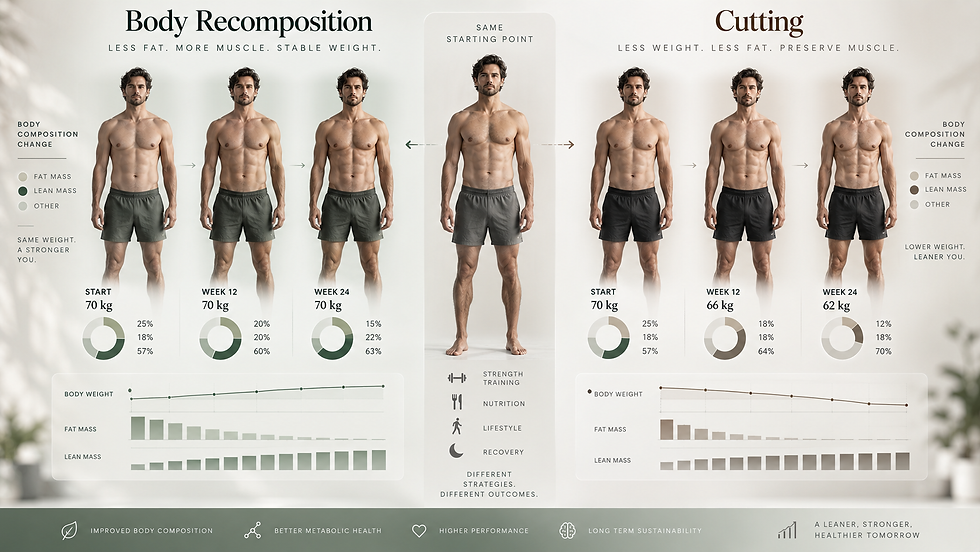
A cut deliberately prioritizes fat loss. You create an energy deficit and aim to reduce body weight and fat mass while preserving as much muscle and training performance as reasonably possible.
Body recomposition, on the other hand, aims to reduce fat mass while simultaneously building or preserving lean tissue. Because muscle can increase while fat decreases, scale weight may change very little even when your physique changes substantially.
Neither strategy is universally better.
The question isn't whether cutting or recomp is better. It's which strategy matches your current body composition, training history and primary goal.
Let's look at how to make that decision.
Body Recomposition vs Cutting: Quick Comparison
The simplest way to understand body recomposition vs cutting is to compare what each strategy prioritizes.
Body Recomposition | Cutting | |
Primary goal | Lose fat while building/preserving muscle | Reduce body fat |
Calories | Maintenance or controlled deficit depending on context | Deliberate calorie deficit |
Scale weight | May change slowly or remain stable | Usually trends downward |
Fat loss speed | Usually slower | Usually faster |
Muscle gain | Often part of the objective | Possible, but secondary |
Resistance training | Essential | Essential for muscle retention |
Protein | High priority | High priority |
Best progress indicators | Waist, body fat, photos, strength, weight | Weight trend, waist, body fat, performance |
Typical duration | Often months | Defined fat-loss phase |
The important difference isn't whether both approaches can reduce fat. They can.
The difference is what you're asking your body to prioritize.
What Is Body Recomposition?
Body recomposition describes the process of reducing fat mass while simultaneously increasing—or at least preserving and improving—lean tissue.
This creates an unusual situation where your physique can change substantially without a dramatic change in body weight.
Imagine someone who loses 3 kg of fat while gaining 2 kg of lean tissue. The scale only shows a 1 kg reduction, yet waist circumference, muscular definition, strength and overall appearance may have changed considerably.
This is why body recomposition should never be evaluated from scale weight alone.
Resistance training, adequate protein, appropriate energy intake and progressive training are fundamental components of the process. How easily someone can build muscle while losing fat depends heavily on their starting point and training experience.
If you want the complete process rather than the comparison covered here, read my Body Recomposition: The Complete Evidence-Based Guide to Losing Fat and Building Muscle.
What Is Cutting?
Cutting is a structured nutritional phase where the primary objective is to reduce body fat through a deliberate energy deficit while preserving as much lean mass as possible.
Although the term comes largely from bodybuilding culture, you don't need to be preparing for a bodybuilding competition to use a cutting phase.
A well-designed cut is simply a controlled fat-loss period.
The distinction between this and crash dieting is important. Cutting doesn't mean eating as little as possible or trying to lose the maximum amount of weight every week.
An effective cut still prioritizes resistance training, sufficient protein, recovery and an appropriate rate of weight loss.
The objective isn't simply:
lose weight.
It's closer to:
lose primarily fat while protecting the muscle you've worked to build.
The Biggest Difference Is Your Primary Goal
Imagine two people who both want to look leaner.
The first has relatively little resistance-training experience and wants to develop more muscle while gradually reducing body fat. Losing 5 kg as quickly as possible isn't particularly important.
The second already has a substantial muscular base but is carrying more body fat than desired. Their primary goal is now to reveal the muscle they've already built.
Their desired outcome may look similar, but their immediate problems are different.
The first person may benefit from recomposition.
The second may benefit more from a dedicated cut.
This is why choosing a nutritional strategy based solely on what is currently popular online makes little sense.
Your current problem should determine your current phase.
Calories: Body Recomposition vs Cutting
Calories are where the distinction becomes clearer.
A successful cutting phase requires an energy deficit over time. If energy intake consistently matches expenditure, substantial weight loss cannot continue indefinitely.
Body recomposition is more nuanced.
Depending on the individual, recomposition can occur around maintenance calories or within a controlled calorie deficit. Training experience, body-fat level, protein intake and the quality of the resistance-training stimulus all influence how realistic simultaneous muscle gain and fat loss will be.
A beginner carrying substantial body fat and starting structured resistance training is physiologically different from a lean natural lifter with ten years of progressive training.
They shouldn't automatically receive the same nutritional strategy.
This is also why I don't like starting with an arbitrary calorie number simply because a calculator produced it.
Establish Your Real Maintenance Before Choosing a Strategy
Before deciding whether someone needs a recomp or cut, I first want to understand their actual starting point.
Equations can estimate basal metabolic rate and total daily energy expenditure, but an equation doesn't know how much you actually move, whether your calorie tracking is accurate, how your weight has been changing or how your body responds to your current intake.
When the baseline isn't clear, I prefer collecting approximately 2–3 weeks of consistent data before making unnecessary adjustments.
Depending on the individual, I may monitor average calorie and protein intake, seven-day average body weight, waist circumference, daily steps, resistance-training performance, training volume, hunger and recovery.
If someone averages 2,200 kcal while weight and waist remain relatively stable across several weeks, that real-world response gives us useful information.
We can then decide whether maintaining intake, creating a small deficit or entering a more deliberate cutting phase makes sense.
A calorie calculator gives you a starting hypothesis. Your actual response tells you what your maintenance really looks like.
For a deeper explanation of this process, see my Body Recomposition Calories guide.

Does Body Recomposition Require a Calorie Deficit?
Not necessarily.
Someone who is relatively untrained may build muscle rapidly when introduced to an effective resistance-training programme. If they also carry sufficient body fat, fat mass can decrease while lean mass increases without requiring an aggressive calorie deficit.
This tends to be more realistic in beginners, people returning to resistance training after a long break and individuals with higher levels of body fat.
The situation becomes progressively more difficult as someone becomes leaner and more highly trained.
An advanced lifter already closer to their muscular potential has much less room for rapid muscle gain. Trying to simultaneously lose meaningful amounts of fat and add significant muscle may therefore become inefficient.
At that point, dedicated phases can make more sense.
How Large Should a Cutting Deficit Be?
There isn't one calorie deficit that works best for everyone.
As a practical framework, I often think about deficits approximately like this:
Deficit | General Context |
~5–10% | Small, conservative deficit |
~10–20% | Moderate deficit |
>20% | More aggressive approach with greater potential trade-offs |
These aren't universal prescriptions.
A larger deficit may accelerate weight loss, but it can also increase hunger, reduce training performance and make recovery and adherence more difficult. The leaner and more highly trained someone becomes, the more important these trade-offs can become.
Instead of asking “How little can I eat?”, I prefer asking:
What is the highest calorie intake that still produces the desired rate of fat loss?
The goal is to use the smallest effective intervention rather than immediately maximizing restriction.
Which Approach Loses Fat Faster?
A dedicated cutting phase will generally produce faster fat loss than a conservative recomp strategy because the energy deficit is deliberately designed to produce it.
This doesn't automatically make cutting better.
Speed is only one variable.
If someone has little muscle and aggressively cuts simply because they want to become lean, they may successfully become lighter without developing the physique they actually wanted.
On the other hand, someone with substantial body fat who spends years attempting an extremely slow recomp may be using an unnecessarily inefficient strategy when fat loss is clearly the priority.
The objective determines whether speed is useful.
Which Approach Builds More Muscle?
Body recomposition places more emphasis on muscle development than a dedicated cutting phase, but that doesn't mean recomp is always the fastest way to build muscle.
For beginners, gaining muscle while losing fat can be realistic because the training stimulus is novel.
For advanced lifters, gaining additional muscle becomes progressively harder. A dedicated muscle-building phase with sufficient energy availability may eventually be more effective than remaining around maintenance indefinitely.
That's why body composition often works better as a sequence of phases rather than one permanent diet.
We'll explore this further in Body Recomposition vs Bulking.
Can You Build Muscle While Cutting?
Yes—but the likelihood depends on who you are.
Muscle gain during a calorie deficit is generally more realistic in people who are new to resistance training, returning after detraining, carrying more body fat or responding to a substantially improved training and protein strategy.
It becomes more difficult when someone is already highly trained, very lean or using a large calorie deficit.
This is why statements such as “you can't build muscle in a deficit” are too absolute, while “everyone can build muscle while cutting” is equally misleading.
Context determines the probability.
Who Should Consider Body Recomposition?
Body recomposition can be particularly useful when fat loss isn't the only problem.
Beginners often have significant potential for muscular adaptation because resistance training provides a completely new stimulus. People returning after a long training break may also regain lost tissue relatively quickly due to previously developed adaptations.
People carrying moderate or higher body fat can also be good candidates in the appropriate context, particularly when structured resistance training and adequate protein are introduced.
Another important group is people commonly described as “skinny-fat”: body weight may appear relatively normal, but muscle mass is low relative to body fat.
For these individuals, simply losing more scale weight may not solve the actual body-composition problem.
Should Skinny-Fat People Cut or Recomp?
Imagine someone who isn't particularly heavy but has limited muscular development around the shoulders, chest, back and legs while carrying more fat around the waist than they would like.
An aggressive cut might reduce their waist, but it may also simply create a smaller version of the same physique.
For many people in this situation, developing muscle is at least as important as losing fat.
A structured resistance-training programme, adequate protein and appropriately controlled calories may therefore be more useful than immediately pursuing aggressive weight loss.
This doesn't mean every skinny-fat individual should automatically recomp. Starting body composition, training experience and personal goals still matter.
But it illustrates why scale weight alone shouldn't determine the strategy.
Who Should Consider Cutting?
A cut becomes more attractive when fat loss is clearly the primary objective.
Someone may already have a reasonable muscular base but want to reduce waist circumference and body-fat levels. In that case, attempting an extremely slow recomp could unnecessarily extend the process.
Similarly, someone carrying substantially more body fat may benefit from prioritizing fat loss before later moving toward maintenance or a dedicated muscle-building phase.
Resistance training remains essential.
Cutting shouldn't mean replacing progressive resistance training with endless high-repetition circuits simply because they burn more calories.
The calorie deficit drives weight loss. Resistance training helps give the body a reason to retain muscle.
Should You Cut or Recomp Based on Body-Fat Percentage?
You'll often see rules online such as “above X% body fat, cut” or “below X%, bulk.”
They're attractive because they're simple.
Human physiology isn't.
Body-fat measurements themselves contain error. DEXA, BIA, skinfolds and circumference-based equations can produce different estimates, while hydration and measurement conditions can affect some methods.
Two people at the same estimated body-fat percentage can also have completely different amounts of muscle, fat distribution, training experience and goals.
Body-fat percentage is useful information.
It isn't the entire decision.
Body-fat percentage can inform the strategy. It shouldn't make the strategy.

Recomp vs Cut for Beginners and Advanced Lifters
Beginners represent one of the strongest cases for body recomposition because their distance from their muscular potential is large. When resistance training is introduced properly, strength and muscle can improve relatively quickly compared with an advanced athlete.
This doesn't mean beginners can ignore calories or protein. It means they often don't need to choose between “lose all the fat first” and “bulk immediately.”
The situation changes as training experience increases.
An advanced natural lifter may spend months trying to recomp while producing almost imperceptible changes because muscle growth is already slow under optimal conditions.
More clearly defined phases can then become useful:
Fat-loss phase → Maintenance → Muscle-building phase
The strategy becomes more specific as the athlete becomes more advanced.
Why You Shouldn't Recomp Forever
Body recomposition is a strategy, not a permanent nutritional identity.
A common mistake is spending years trying to stay around exactly the same weight while simultaneously hoping to become dramatically leaner and more muscular.
Eventually progress becomes extremely slow.
At that point, committing to a specific phase may provide a stronger signal. You might need to cut, you might need to build, or you might simply need a period of maintenance before deciding what comes next.
Recomposition works best when it solves a specific problem—not when it becomes an excuse to avoid choosing a direction.
When Should You Stop Recomping or Cutting?
A cut may become appropriate when fat loss becomes the clear priority and your current recomp approach is no longer producing sufficient change.
Perhaps strength and muscle development have improved, but waist circumference and fat mass are now the primary variables you want to reduce. If your maintenance baseline is established and training is stable, introducing a controlled deficit can make the fat-loss objective more explicit.
A cut shouldn't continue indefinitely either.
You may finish because you've reached your body-composition goal, but increasing diet fatigue, declining training performance, poor recovery, persistent hunger or reaching the planned end of the phase may also influence the decision.
Successful body composition isn't about remaining in one phase forever.
It's about knowing when to change phase.
Why Scale Weight Can Mislead You
The scale is useful, but its importance differs between recomp and cutting.
During a cut, I generally expect a downward weight trend over time. A seven-day average is usually more useful than reacting to individual mornings.
During a recomp, scale weight may move much more slowly.
Imagine Person A loses 4 kg, but part of that reduction comes from lean tissue. Person B loses 3 kg of fat while gaining approximately 2 kg of lean tissue. Person B has only lost around 1 kg on the scale, yet may show the larger visual transformation.
That's why I prefer combining:
Body weight + waist + body-fat estimate + progress photos + strength + training performance
If your weight hasn't changed but your waist has decreased, your lifts have improved and your physique looks noticeably different, declaring the programme a failure because the scale is stable makes little sense.

Real-World Example: Why the Right Phase Changes Over Time
One of my clients, Matteo, is a good example of why body composition shouldn't be approached as one permanent diet.
He started at close to 100 kg, with body fat estimated around 26%. Over the course of his transformation, he lost more than 25 kg, eventually reaching approximately 12% body fat.
His waist decreased from approximately 93.5 cm to 72.5 cm, while abdominal circumference moved from approximately 96 cm to 75.5 cm.
But the important part wasn't simply that he “went on a diet.”
His strategy changed throughout the process.
Periods of calorie reduction were followed by phases where calories were progressively increased and the focus shifted toward performance, maintenance and further body-composition development. Resistance training remained part of the process instead of treating weight loss as purely a calorie-burning exercise.
This is the part that before-and-after photos often fail to show.
A long transformation isn't one phase.
It's a sequence of decisions.

Body Recomposition vs Cutting: A Practical Decision Framework
Rather than choosing a strategy from one body-fat percentage or an online calculator, evaluate the complete starting point.
Situation | Strategy to Consider |
Beginner + moderate body fat | Recomposition may be appropriate |
Returning after a long training break | Recomposition may be appropriate |
Skinny-fat physique | Often prioritize recomp/muscle development |
Higher body fat + fat loss main priority | Cutting may be more efficient |
Muscular but wants leaner physique | Cutting |
Lean advanced lifter wanting more muscle | Consider dedicated building phase |
Maintenance intake unclear | Establish baseline first |
Significant diet fatigue / poor recovery | Maintenance may be appropriate |
These aren't rigid rules. They're starting points for decision-making.
My process is:
1. Assess: Understand body composition, current intake, training history, activity and recovery.
2. Establish the baseline: Determine what is actually happening at the current calorie intake rather than relying exclusively on predictions.
3. Define the primary goal: Is the immediate problem too much fat, too little muscle, or both?
4. Decide: Choose recomp, cut, maintenance or a muscle-building phase based on the problem you're trying to solve.
5. Execute: Give the strategy enough time to produce meaningful information.
6. Measure: Track multiple variables rather than scale weight alone.
7. Adjust: When the data changes, the strategy may need to change too.
ASSESS → DECIDE → EXECUTE → MEASURE → ADJUST
Common Body Recomposition vs Cutting Mistakes
The most common mistake is cutting when the real problem is insufficient muscle mass. Becoming lighter doesn't automatically create a more athletic physique.
The opposite mistake is recomping indefinitely when fat loss is clearly the priority. Sometimes a dedicated calorie deficit is simply more efficient.
Other common problems include relying entirely on body-fat percentage, creating unnecessarily aggressive deficits, consuming insufficient protein, failing to progressively train, reacting emotionally to daily scale fluctuations and changing calories so frequently that no meaningful trend has time to develop.
Body composition requires enough consistency to produce interpretable data.
Frequently Asked Questions
Is Body Recomposition Better Than Cutting?
Neither is universally better. Body recomposition prioritizes simultaneous improvements in fat and muscle, while cutting prioritizes fat loss. The appropriate strategy depends on your starting body composition, training experience and primary goal.
Should I Cut or Recomp?
If you're a beginner, returning after detraining or have relatively little muscle, recomp may be appropriate. If you already have a reasonable muscular base and fat loss is clearly your main priority, a dedicated cut may be more efficient.
Is Recomp Just a Small Calorie Deficit?
No. Some recomposition strategies use a small deficit, but recomp can also occur around maintenance depending on the individual and circumstances.
Can I Build Muscle During a Cut?
Yes, particularly if you're a beginner, detrained or carrying more body fat. It becomes progressively harder for lean, highly trained athletes and during aggressive deficits.
Should Skinny-Fat People Cut or Recomp?
Often, developing muscle should be a major priority because simply losing more weight can produce a smaller physique without addressing low muscularity. Individual circumstances still matter.
At What Body-Fat Percentage Should I Cut?
There is no universal percentage. Body-fat estimates contain measurement error, and training history, muscularity, fat distribution and goals should also influence the decision.
How Long Should a Body Recomp Last?
There is no fixed duration. Recomposition may continue for several months while meaningful changes occur. When progress slows or one objective becomes clearly more important, transitioning to another phase may make sense.
Is Cutting Faster Than Body Recomposition?
For fat loss specifically, a dedicated cut is generally faster because it deliberately creates an energy deficit. Faster isn't automatically better if muscle development is also a major priority.
Can I Recomp at Maintenance Calories?
Yes, particularly in favourable circumstances such as beginners or people returning to resistance training. The likelihood depends on training status, body composition, protein intake and the quality of the training stimulus.
When Should I Stop Recomping?
Consider changing phases when progress has meaningfully slowed or when either fat loss or muscle growth becomes a sufficiently clear priority that a dedicated phase would be more efficient.
Choose a Phase, Not a Label
Body recomposition and cutting aren't competing diets. They're different tools.
A cut prioritizes reducing fat mass while preserving as much muscle as possible. A recomp attempts to improve both sides of the body-composition equation at the same time.
The correct choice depends on where you're starting, how long you've been training, how much muscle you currently carry, your body-fat level, your timeline and what you actually want to change.
And that choice doesn't have to be permanent.
The strategy that works for you today may no longer be the best strategy six months from now because your body composition has changed.
Don't ask whether cutting or body recomposition is better. Ask which phase solves the problem your body currently has.
Ready to Choose the Right Body Recomposition Strategy?
Knowing the difference between body recomposition and cutting is useful. Knowing which strategy actually fits your body, training history, current calorie intake and goals is what matters.
If you want a personalized approach, you can work directly with me to assess your current body composition, establish your real starting point and build a nutrition and training strategy around your data rather than relying on generic calorie calculators or fixed body-fat rules.
Prefer to Build Your Own Strategy?
My Body Recomposition Blueprint takes you through the complete framework I use to approach body composition—from assessment and calorie calculation to choosing the right nutritional phase, structuring training, tracking progress and knowing when to adjust.


Comments