


Peptides for Weight Loss and Muscle Gain: What Does the Evidence Actually Say?

“Peptides” have become one of the most popular—and most misunderstood—words in the fitness, weight-loss and longevity industries.
Scroll through social media and you will find peptides promoted for almost everything: losing body fat, increasing muscle mass, improving recovery, healing injuries, controlling appetite and even slowing ageing.
The problem is that peptides are not one treatment.
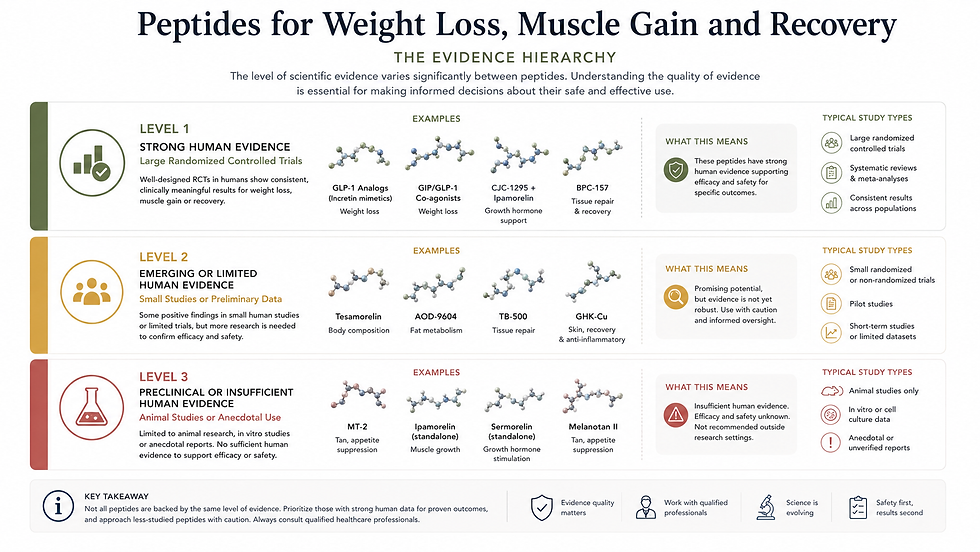
Semaglutide, tirzepatide, CJC-1295, ipamorelin and BPC-157 may all appear in conversations about peptides, but they have completely different mechanisms, levels of evidence and regulatory status. Putting them into the same category simply because they are peptides can be extremely misleading.
This becomes even more important when discussing peptides for weight loss and muscle gain, because losing weight and improving body composition are not necessarily the same thing.
Some peptide-based medications have produced substantial weight loss in large randomized clinical trials. Evidence that commonly marketed “muscle-building peptides” meaningfully increase muscle mass in healthy people, however, is far less convincing.
And even when a medication helps someone lose a significant amount of weight, another question remains:
How much of that weight comes from fat—and how much comes from lean tissue?
Understanding that distinction is essential if your objective isn't simply seeing a smaller number on the scale, but improving your overall body composition.
Important: This article is educational and does not provide peptide protocols, dosing recommendations or individual medical advice. Prescription medications should be considered with an appropriately qualified healthcare professional.
What Are Peptides and Why Are They Suddenly Everywhere?
Peptides are short chains of amino acids, the same basic building blocks that form proteins.
Your body naturally produces many peptides that act as signalling molecules and participate in processes ranging from appetite regulation and metabolism to hormone signalling.
But saying that something is a “peptide” tells you very little about what it actually does.
Two peptide-based compounds can interact with completely different receptors and produce completely different physiological effects. This is why treating “peptides” as if they were one class of fat-burning or muscle-building substances makes little scientific sense.
The recent explosion in interest is partly connected to the success of incretin-based medications used in obesity and diabetes treatment. Semaglutide, for example, is a GLP-1 analogue, while tirzepatide acts as a dual GIP and GLP-1 receptor agonist.
At the same time, another market has developed around so-called research peptides promoted for muscle growth, recovery and fat loss.
That creates three very different categories that are frequently mixed together online:
Clinically studied and approved medications
Experimental drugs currently being investigated
Unapproved compounds marketed directly to consumers
The distinction matters enormously.
A compound producing an interesting biological effect in a laboratory or small early-stage study is not equivalent to a medication supported by large randomized clinical trials.
And neither should automatically be considered equivalent to a vial purchased from an unknown website.

Can Peptides Really Help With Weight Loss and Muscle Gain?
This is where the answer becomes more complicated.
If the question is whether certain peptide-based medications can help produce clinically significant weight loss, the answer is clearly yes for specific approved medications used in appropriate patients.
If the question is whether there is a peptide that reliably causes substantial fat loss while simultaneously building significant amounts of muscle, the evidence is much less impressive.
These are two separate physiological objectives.
Fat loss fundamentally requires stored energy to be mobilised over time. Muscle hypertrophy requires sufficient training stimulus, amino acids, recovery and an environment capable of supporting muscle-protein synthesis
They can occur simultaneously under certain circumstances—which is the basis of body recomposition—but one medication doesn't automatically create both adaptations.
This distinction is often lost when dramatic before-and-after transformations are presented online.
Imagine someone goes from 110 kg to 90 kg.
They have lost 20 kg.
That's an impressive change in body weight, but it doesn't tell us exactly what happened to their body composition.
Ideally, most of that reduction would come from fat mass while as much functional lean tissue as possible is preserved.
That's why the better question isn't simply:
“How much weight did I lose?”
It's also:
“What did I lose?”
GLP-1–Based Drugs: The Strongest Evidence for Weight Loss
Among substances commonly included in online discussions about weight-loss peptides, incretin-based medications such as semaglutide and tirzepatide have by far some of the strongest clinical evidence.
These aren't bodybuilding supplements or conventional “fat burners.” They are medications developed and studied for specific medical indications.
Semaglutide
Semaglutide is a GLP-1 receptor agonist.
GLP-1 is involved in several physiological processes, including appetite and food-intake regulation. Pharmacological GLP-1 receptor activation can increase satiety and make sustained reductions in energy intake considerably easier for some patients.
The STEP 1 randomized trial included 1,961 adults with overweight or obesity without diabetes. After 68 weeks, mean body-weight change was approximately −14.9% with semaglutide 2.4 mg versus −2.4% with placebo, alongside lifestyle intervention.
Those results help explain why the discussion around weight-loss medication has changed so dramatically.
But semaglutide isn't directly “burning fat” in the way fitness marketing sometimes implies.
One of its major effects is changing the biological regulation of appetite and food intake, making a sustained calorie deficit more achievable.
Tirzepatide
Tirzepatide works differently. It is a dual GIP and GLP-1 receptor agonist.
In the SURMOUNT-1 trial involving 2,539 adults with obesity or overweight and at least one weight-related complication, mean weight reduction after 72 weeks was approximately 15.0%, 19.5% and 20.9% across the three studied tirzepatide doses, compared with 3.1% with placebo under the treatment-regimen analysis.
Those are substantial changes.
But once weight loss becomes that large, body composition becomes increasingly important.
Because the goal shouldn't necessarily be to make body weight decrease as rapidly as possible.
The objective should be to improve health and reduce excess fat while preserving as much valuable tissue and physical function as possible.

Do Weight-Loss Peptides Cause Muscle Loss?
This is one of the most important questions surrounding modern weight-loss medications.
When someone loses a large amount of weight, not everything lost is necessarily adipose tissue. Some reduction in lean mass commonly occurs during weight loss as well.
That isn't unique to GLP-1–based therapy.
Lean tissue can also be lost during conventional calorie-restricted diets, particularly when weight loss is rapid and resistance training, protein intake and other muscle-preserving factors are inadequate.
A DXA substudy of SURMOUNT-1 provides a useful example. Among 160 participants with body-composition measurements, tirzepatide was associated with an average 21.3% reduction in body weight, 33.9% reduction in fat mass and 10.9% reduction in lean mass over 72 weeks. Approximately 75% of the weight lost was fat mass and 25% lean mass. citeturn0search6
That does not mean tirzepatide simply “eats your muscles,” as some social-media headlines suggest.
It demonstrates something more useful:
Weight loss and fat loss are not interchangeable outcomes.
Lean mass measured by DXA also isn't identical to skeletal muscle—the lean compartment includes water and other non-fat tissues—so changes in DXA lean mass shouldn't automatically be interpreted as an equal amount of contractile muscle disappearing.
Nevertheless, preserving muscle and physical function should become part of the conversation when substantial weight loss is expected.
This is where resistance training becomes particularly important.
A well-designed resistance-training programme provides the body with a reason to retain muscle tissue during an energy deficit.
Adequate dietary protein provides the amino acids required to support muscle-protein turnover.
And the size of the calorie deficit, training performance, recovery and rate of weight loss all become relevant variables.
This is exactly why I prefer to look at body composition rather than body weight alone.
A successful intervention shouldn't necessarily be judged by who loses the most kilograms in the shortest period.
The better outcome may be the person who loses substantial fat while maintaining strength, muscle tissue and physical function.

Can You Build Muscle While Taking a GLP-1 Medication?
Potentially, but the medication itself shouldn't be confused with the muscle-building stimulus.
Whether someone can build muscle while losing weight depends on multiple factors.
A beginner starting resistance training may be capable of gaining muscle even while losing substantial fat. Someone returning to training after a long break may also regain previously developed muscle relatively quickly.
People carrying more body fat may have more energetic flexibility to support recomposition than already-lean advanced athletes.
Training experience, calorie intake, protein intake, sleep, recovery and the quality of the resistance-training programme all influence the outcome.
The key point is:
A medication may make eating less easier. It doesn't replace the muscular stimulus required to preserve or build muscle.
If appetite becomes extremely low and protein intake falls dramatically, simply losing more weight isn't automatically a better result.
For someone using medically indicated weight-loss treatment, nutritional quality and resistance training therefore become more—not less—important.
If you want to understand this process in more detail, my guides to Body Recomposition Workout, Protein Powder for Body Recomposition and Body Recomposition Calories explain how training stimulus, protein and energy balance interact during fat loss.
What About Peptides Marketed for Muscle Gain?
This is where the evidence becomes much weaker than the marketing.
Compounds such as CJC-1295 and ipamorelin frequently appear in discussions about muscle-building peptides because of their interaction with the growth-hormone axis.
The reasoning sounds convincing:
Peptide → increased GH signalling → increased IGF-1 → more muscle
But physiology rarely works that simply.
CJC-1295
CJC-1295 is a long-acting analogue of growth-hormone-releasing hormone.
A small randomized study published in 2006 found that CJC-1295 could produce sustained increases in circulating GH and IGF-1 in healthy adults. citeturn1search1
That's biologically interesting.
But demonstrating increased GH and IGF-1 is not the same as demonstrating clinically meaningful increases in skeletal-muscle hypertrophy, strength or athletic performance.
The study was designed primarily around pharmacokinetics and hormonal responses—not to establish CJC-1295 as an effective muscle-building treatment.
The FDA also notes that available clinical data for CJC-1295 are limited and lists potential safety concerns associated with compounded products containing it.
Ipamorelin
Ipamorelin is another growth-hormone-releasing peptide.
Early human research demonstrated that it can stimulate GH release. For example, a pharmacokinetic/pharmacodynamic study in healthy male volunteers showed a GH response following administration.
Again:
GH release ≠ proven muscle growth.
This is a critical distinction.
The FDA currently states that it lacks sufficient safety information for certain injectable uses of compounded ipamorelin and identifies potential concerns including immunogenicity and peptide-related impurities.
So while the proposed mechanism can sound attractive to someone interested in bodybuilding, the evidence shouldn't be presented as equivalent to established interventions for increasing muscle mass.
Resistance training, adequate protein, appropriate energy intake and progressive overload have vastly more practical evidence behind them.
Evidence Matters More Than the Mechanism
This deserves emphasis because it applies to almost every emerging performance compound.
A substance may:
increase a hormone;
activate a receptor;
alter a signalling pathway;
produce an effect in rodents;
produce an interesting biomarker change in humans.
None of those findings automatically demonstrate that it produces meaningful muscle gain or fat loss in real people.
A mechanism tells us why something might work.
A well-designed clinical trial helps determine whether it actually does.
This distinction is one of the easiest things to lose when health information is compressed into a 30-second social-media video.
What About BPC-157 and Other “Recovery Peptides”?
BPC-157 is another name that frequently appears in peptide discussions.
It is commonly promoted online for tendon healing, muscle recovery, gastrointestinal health and injury rehabilitation.
But “commonly promoted” and “clinically established” are very different things.
Much of the enthusiasm around BPC-157 has historically come from preclinical research rather than robust human clinical trials demonstrating meaningful improvements in recovery or muscle growth.
The FDA currently states that compounded BPC-157 may present risks including immunogenicity and problems related to peptide impurities and API characterization. It also notes that it has identified no or only limited safety information for proposed routes of administration and therefore lacks sufficient information to determine whether the drug would cause harm in humans.
This doesn't prove that every proposed biological effect of BPC-157 is impossible.
It means the level of certainty should match the quality of the evidence.
The same principle applies to other compounds marketed as “recovery peptides.”
And there is another conceptual problem:
Recovery isn't the same thing as muscle hypertrophy.
Even if a compound eventually proves useful for a particular recovery application, that doesn't automatically make it a muscle-building drug.
Retatrutide: What About the Next Generation of Weight-Loss Drugs?
Retatrutide has attracted enormous attention because it targets three metabolic hormone receptors: GIP, GLP-1 and glucagon receptors.
That makes it scientifically interesting, and its clinical development is worth following.
But this is exactly where readers need to separate clinical research from products already approved for medical use.
As of August 2026, the FDA states that retatrutide cannot be used in compounding under U.S. federal law, is not a component of an FDA-approved drug and has not been found safe and effective for any condition.
That status may change in the future as clinical development progresses.
But today, seeing “retatrutide” offered for sale online does not mean someone is purchasing an approved version of a future medication.
This distinction becomes increasingly important as excitement around new obesity treatments creates demand before regulatory approval.
The Biggest Problem With “Research Peptides” Sold Online
One of the biggest risks in the peptide conversation isn't simply whether a particular molecule works.
It's knowing what is actually inside the product.
Clinical research uses compounds manufactured and controlled according to defined standards.
A vial purchased from an anonymous website labelled “research use only” should not automatically be assumed to have the same purity, concentration, sterility or identity as the substance described in a published clinical trial.
Potential problems include incorrect concentration, contamination, peptide-related impurities, counterfeit labelling and poor storage or manufacturing controls.
This isn't merely theoretical.
In 2026, the FDA has continued taking action against businesses marketing unapproved peptide and GLP-1 products. The agency specifically warns that unapproved versions of semaglutide and tirzepatide don't undergo FDA review for safety, effectiveness and quality before marketing, and it has reported fraudulent compounded products carrying false pharmacy information.
The FDA reported that, through May 31, 2026, it had received 990 adverse-event reports associated with compounded semaglutide and more than 730 associated with compounded tirzepatide, while noting that these reports don't necessarily establish that the compounded product caused the event.
This doesn't mean all legitimate compounding should be treated as identical to anonymous online peptide sales. There are specific circumstances and legal frameworks in which compounded medications may be appropriate.
But compounded drugs are not FDA-approved drugs, and the FDA recommends that compounded GLP-1 drugs be used only when a patient's medical needs cannot be met by an approved drug.
The broader principle is simple:
The molecule described in a clinical trial and a vial purchased from an unknown website should not be treated as equivalent products.

Peptides vs Body Recomposition: What Actually Preserves Muscle?
This is where the peptide conversation comes back to the fundamental principles of body recomposition.
Medication can potentially influence:
Appetite → food intake → calorie balance → body weight
But maintaining or building muscle requires another set of signals.
The most important is resistance training.
When you train a muscle with sufficient tension and progressively challenge it over time, you're providing a stimulus for adaptation. During weight loss, that training signal also helps tell the body that the tissue remains functionally valuable.
Protein provides the amino acids required to support that process.
Calories determine the broader energy environment.
Recovery influences your ability to repeatedly produce a meaningful training stimulus.
So if someone is losing weight rapidly because appetite has fallen dramatically but they're barely consuming protein, have stopped training and are becoming progressively weaker, celebrating the scale alone misses the bigger picture.
Compare that with someone losing weight while:
resistance training consistently;
maintaining or improving key lifts where possible;
consuming adequate protein;
monitoring their rate of weight loss;
maintaining daily activity;
recovering adequately;
monitoring waist, body weight and body composition rather than weight alone.
The second approach is much closer to what I consider successful body recomposition.
The medication, where medically appropriate, may be one tool within the process.
It isn't the process itself.

Who Should Consider Medical Weight-Loss Treatment?
This is a medical question rather than a fitness-hack question.
Anti-obesity medications are intended for specific clinical situations and should be considered alongside medical history, current health, potential contraindications, other medications, expected benefits and possible adverse effects.
They aren't simply the next progression after diet and exercise “fail,” nor should they automatically be viewed as an easy shortcut.
Obesity is a complex chronic disease, and pharmacological treatment can be an important tool for appropriately selected patients.
At the same time, someone who simply wants to become slightly leaner for aesthetic reasons shouldn't assume that a medication used to treat obesity automatically has a favourable risk-benefit profile for their situation.
That's a decision to make with an appropriately qualified healthcare professional—not TikTok, a bodybuilding forum or an online peptide store.
Frequently Asked Questions About Peptides for Weight Loss and Muscle Gain
What are the best peptides for weight loss and muscle gain?
There isn't one peptide that can currently be described scientifically as “the best” for simultaneously losing fat and building muscle.
Certain approved incretin-based medications have strong evidence for weight management in appropriate patients. Evidence for many peptides promoted specifically for muscle gain is considerably weaker.
Muscle preservation or growth still depends heavily on resistance training, protein intake, energy availability and recovery.
Can peptides burn fat and build muscle at the same time?
Some medications can facilitate substantial weight loss, while body recomposition may occur simultaneously under the right conditions.
But that doesn't mean the medication itself is directly creating muscle hypertrophy.
A person who begins resistance training, consumes sufficient protein and loses fat may gain muscle while their body weight decreases—particularly if they're relatively inexperienced with resistance training.
Does semaglutide cause muscle loss?
Weight loss with semaglutide can include reductions in lean mass, just as weight loss through other methods can.
However, describing this simply as “semaglutide destroys muscle” isn't supported by the nuance of body-composition measurement. Lean mass isn't synonymous with skeletal muscle, and the amount preserved may be influenced by factors such as training, protein intake, magnitude of weight loss and individual characteristics.
Does tirzepatide cause muscle loss?
In the SURMOUNT-1 DXA substudy, approximately 75% of weight lost with tirzepatide came from fat mass and approximately 25% from lean mass.
That makes lean-tissue preservation an important consideration during substantial weight loss, rather than evidence that tirzepatide specifically targets muscle.
Can you build muscle while taking a GLP-1 medication?
It may be possible, particularly in beginners, people returning to training or individuals with substantial fat mass.
However, resistance training remains necessary to provide a meaningful hypertrophy stimulus, and adequate protein and nutrition remain important.
Are peptides safe for muscle growth?
“Peptides” are too broad a category for a universal safety answer.
Different compounds have different evidence, adverse-effect profiles and regulatory statuses. Many products marketed online for muscle growth aren't approved treatments for that purpose and may have limited human safety data.
Is BPC-157 a muscle-building peptide?
BPC-157 is frequently marketed for recovery and tissue healing rather than established muscle hypertrophy. Robust human evidence supporting it as a muscle-building treatment is lacking, and the FDA has identified significant gaps in safety information for compounded BPC-157.
Is retatrutide approved for weight loss?
No, as of August 2026 in the United States.
The FDA states that retatrutide isn't a component of an FDA-approved drug, hasn't been found safe and effective for any condition, and cannot be used in compounding under federal law.
Because this is an actively developing area, its regulatory status should always be checked against current official information rather than older articles or social-media posts.
Peptides for Weight Loss and Muscle Gain: The Bottom Line
Peptides are going to remain one of the biggest topics in weight management, fitness and longevity over the next few years.
Some deserve that attention.
Others are running considerably ahead of the evidence.
Semaglutide and tirzepatide demonstrate that medications acting on peptide-hormone pathways can produce substantial weight loss in appropriately selected populations.
That doesn't mean every substance marketed as a peptide has comparable evidence.
CJC-1295 and ipamorelin can influence the growth-hormone axis, but demonstrating a hormonal response isn't the same as demonstrating meaningful muscle hypertrophy.
BPC-157 has attracted enormous interest around recovery, but human evidence remains limited and important safety questions remain.
Retatrutide is scientifically promising, but as of August 2026 it remains unapproved in the United States.
The most useful way to evaluate any of these compounds is therefore not to ask:
“Is this peptide good?”
Ask instead:
What outcome has actually been demonstrated?
Was it demonstrated in humans?
How large and well controlled were the studies?
What population was studied?
What are the known risks?
And is the product being discussed actually an approved medication?
Finally, remember that weight loss is not synonymous with body recomposition.
A lower number on the scale tells you nothing about how much fat versus lean tissue you've lost, whether you're stronger or weaker, or whether your physical function has improved.
Medication can change appetite and make substantial weight loss possible.
But if your objective is to lose fat while preserving or building muscle, the fundamentals remain remarkably familiar:
Resistance training. Adequate protein. Appropriate calorie intake. Recovery. Progressive overload. And monitoring more than body weight alone.
Those principles aren't as new or exciting as the latest peptide.
But they're still the foundation on which successful body recomposition is built.
References
Wilding JPH, Batterham RL, Calanna S, et al. Once-Weekly Semaglutide in Adults with Overweight or Obesity. New England Journal of Medicine. 2021;384:989–1002. doi:10.1056/NEJMoa2032183.
Jastreboff AM, Aronne LJ, Ahmad NN, et al. Tirzepatide Once Weekly for the Treatment of Obesity. New England Journal of Medicine. 2022;387:205–216. doi:10.1056/NEJMoa2206038.
Look M, Dunn JP, Kushner RF, et al. Body composition changes during weight reduction with tirzepatide in the SURMOUNT-1 study of adults with obesity or overweight. Diabetes, Obesity and Metabolism. 2025. PMID: 39996356.
Teichman SL, Neale A, Lawrence B, et al. Prolonged stimulation of growth hormone (GH) and insulin-like growth factor I secretion by CJC-1295, a long-acting analog of GH-releasing hormone, in healthy adults.Journal of Clinical Endocrinology & Metabolism. 2006;91(3):799–805. doi:10.1210/jc.2005-1536.
Raun K, Hansen BS, Johansen NL, et al. Ipamorelin, the first selective growth hormone secretagogue.European Journal of Endocrinology. 1998;139(5):552–561.
U.S. Food and Drug Administration (FDA). FDA's Concerns with Unapproved GLP-1 Drugs Used for Weight Loss. Updated information on unapproved and compounded semaglutide, tirzepatide and retatrutide. Accessed August 2026.
U.S. Food and Drug Administration (FDA). Certain Bulk Drug Substances for Use in Compounding May Present Significant Safety Risks. FDA information concerning substances including BPC-157, CJC-1295 and ipamorelin. Accessed August 2026.
U.S. Food and Drug Administration (FDA). Wegovy (semaglutide) prescribing and regulatory information.FDA-approved drug information and safety documentation.
U.S. Food and Drug Administration (FDA). Zepbound (tirzepatide) prescribing and regulatory information.FDA-approved drug information and safety documentation.
Jastreboff AM, Kaplan LM, Frías JP, et al. Triple-Hormone-Receptor Agonist Retatrutide for Obesity — A Phase 2 Trial. New England Journal of Medicine. 2023;389:514–526. doi:10.1056/NEJMoa2301972.


Comments